ComPhyX: July 2017

Friday, 28 July 2017

Have you think what social media gives you?

Yes. You are right. Have you ever thought about it? From the internet, we gain manythings, its true. But you also give manythings to internet.

Here are some are things you take from internet

  • Knowledge
  • Official advantage
  • Working advantage
  • Financial advantage
  • Frienship with stranger???

Do you think friendship with stranger gives you advantage? Chatting with him/her gives you fun? Not at all. Actually this types chatting actually taking you to the not curable illness. You can get cancer on your brain if you are spending more hours on your phone, tablet or your computer/laptop. This social sites actually eats up your memory and brain with your eyes. Your IQ potential also decreases with more spending hour in internet. The more you will be updated to the modernity, you will waste your brain. So keep yourself safe from internet. Specially, who are below 25.

You can browse internet for 20 to 30 minute maximum to search your problem of educational life or working life. But, beside it, you are in danger. Believe it, earth is not in danger, but you are in.


Sunday, 23 July 2017

Airplanes

We take for it granted that we can fly from one side of the world to the other in a matter of hours, but a century ago this amazing ability to race through the air had only just been discovered. What would the Wright brothers—the pioneers of powered flight—make of an age in which something like 100,000 planes take to the sky each day in the United States alone? They’d be amazed, of course, and delighted too. Thanks to their successful experiments with powered flight, the airplane is rightfully recognized as one of the greatest inventions of all time. Let’s take a closer look at how it works!

Photo: You need big wings to lift a big plane like this US Air Force C-17 Globemaster. The wings are 51.75m (169ft) wide—that’s just slightly less than the plane’s body length of 53m (174ft). The maximum takeoff weight is 265,352kg (585,000lb), about as much as 40 adult elephants! Photo by Jeremy Lock courtesy of US Air Force.

How do planes fly?

If you’ve ever watched a jet plane taking off or coming in to land, the first thing you’ll have noticed is the noise of the engines. Jet engines, which are long metal tubes burning a continuous rush of fuel and air, are far noisier (and far more powerful) than traditional propeller engines. You might think engines are the key to making a plane fly, but you’d be wrong. Things can fly quite happily without engines, as gliders (planes with no engines), paper planes, and indeed gliding birds readily show us.
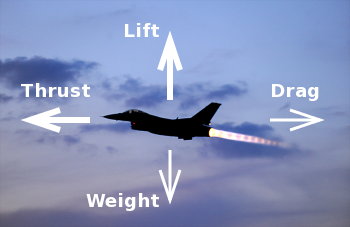
Forces acting on a flying plane: thrust, weight, drag, and lift

Photo: Four forces act on a plane in flight. When the plane flies horizontally at a steady speed, lift from the wings exactly balances the plane’s weight and the thrust exactly balances the drag. However, during takeoff, or when the plane is attempting to climb in the sky (as shown here), the thrust from the engines pushing the plane forward exceeds the drag (air resistance) pulling it back. This creates a lift force, greater than the plane’s weight, which powers the plane higher into the sky. Photo by Nathanael Callon courtesy of US Air Force.

If you’re trying to understand how planes fly, you need to be clear about the difference between the engines and the wings and the different jobs they do. A plane’s engines are designed to move it forward at high speed. That makes air flow rapidly over the wings, which throw the air down toward the ground, generating an upward force called lift that overcomes the plane’s weight and holds it in the sky. So it’s the engines that move a plane forward, while the wings move it upward.

Diagram showing Newton's third law of motion applied to the wings and engines of a plane.

Photo: Newton’s third law of motion explains how the engines and wings work together to make a plane move through the sky. The force of the hot exhaust gas shooting backward from the jet engine pushes the plane forward. That creates a moving current of air over the wings. The wings force the air downward and that pushes the plane upward. Photo by Samuel Rogers (with added annotations by explainthatstuff.com) courtesy of US Air Force. Read more about how engines work in our detailed article on jet engines.

How do wings make lift?

In one sentence, wings make lift by changing the direction and pressure of the air that crashes into them as the engines shoot them through the sky.

Pressure differences

Okay, so the wings are the key to making something fly—but how do they work? Most airplane wings have a curved upper surface and a flatter lower surface, making a cross-sectional shape called an airfoil(or aerofoil, if you’re British):

Photo showing airfoil wing on the NASA Centurion solar-powered plane.
Photo: An airfoil wing typically has a curved upper surface and a flat lower surface. This is the wing on NASA’s solar-powered Centurion plane. Photo by Tom Tschida courtesy of NASA Armstrong Flight Research Center.

In a lot of science books and web pages, you’ll read an incorrect explanation of how an airfoil like this generates lift. It goes like this: When air rushes over the curved upper wing surface, it has to travel furtherthan the air that passes underneath, so it has to go faster (to cover more distance in the same time). According to a principle of aerodynamics called Bernoulli’s law, fast-moving air is at lower pressure than slow-moving air, so the pressure above the wing is lower than the pressure below, and this creates the lift that powers the plane upward.

Although this explanation of how wings work is widely repeated, it’s wrong: it gives the right answer, but for completely the wrong reasons! Think about it for a moment and you’ll see that if it were true, acrobatic planes couldn’t fly upside down. Flipping a plane over would produce “downlift” and send it crashing to the ground. Not only that, but it’s perfectly possible to design planes with airfoils that are symmetrical (looking straight down the wing) and they still produce lift. For example, paper airplanes (and ones made from thin balsa wood) generate lift even though they have flat wings.

The popular explanation of lift is common, quick, sounds logical and gives the correct answer, yet also introduces misconceptions, uses a nonsensical physical argument and misleadingly invokes Bernoulli’s equation.”

Professor Holger Babinsky, Cambridge University

But the standard explanation of lift is problematic for another important reason as well: the air shooting over the wing doesn’t have to stay in step with the air going underneath it, and nothing says it has to travel a bigger distance in the same time. Imagine two air molecules arriving at the front of the wing and separating, so one shoots up over the top and the other whistles straight under the bottom. There’s no reason why those two molecules have to arrive at exactly the same time at the back end of the wing: they could meet up with other air molecules instead. This flaw in the standard explanation of an airfoil goes by the technical name of the “equal transit theory.” That’s just a fancy name for the (incorrect) idea that the air stream splits apart at the front of the airfoil and meets up neatly again at the back.

An airfoil generates lift through a combination of pressure differences and downwash: the air moves down, so the plane moves up.

So what’s the real explanation? As a curved airfoil wing flies through the sky, it deflects air and alters the air pressure above and below it. That’s intuitively obvious. Think how it feels when you slowly walk through a swimming pool and feel the force of the water pushing against your body: your body is diverting the flow of water as it pushes through it, and an airfoil wing does the same thing (much more dramatically—because that’s what it’s designed to do). As a plane flies forward, the curved upper part of the wing lowers the air pressure directly above it, so it moves upward.

Why does this happen? As air flows over the curved upper surface, its natural inclination is to move in a straight line, but the curve of the wing pulls it around and back down. For this reason, the air is effectively stretched out into a bigger volume—the same number of air molecules forced to occupy more space—and this is what lowers its pressure. For exactly the opposite reason, the pressure of the air under the wing increases: the advancing wing squashes the air molecules in front of it into a smaller space. The difference in air pressure between the upper and lower surfaces causes a big difference in air speed (not the other way around, as in the traditional theory of a wing). The difference in speed (observed in actual wind tunnel experiments) is much bigger than you’d predict from the simple (equal transit) theory. So if our two air molecules separate at the front, the one going over the top arrives at the tail end of the wing much faster than the one going under the bottom. No matter when they arrive, both of those molecules will be speeding downward—and this helps to produce lift in a second important way.

How airfoil wings generate lift#1: An airfoil splits apart the incoming air, lowers the pressure of the upper air stream, and accelerates both air streams downward. As the air accelerates downward, the wing (and the plane) move upward. The more an airfoil diverts the path of the oncoming air, the more lift it generates.

Downwash

If you’ve ever stood near a helicopter, you’ll know exactly how it stays in the sky: it creates a huge “downwash” (downward moving draft) of air that balances its weight. Helicopter rotors are very similar to airplane airfoils, but spin around in a circle instead of moving forward in a straight line, like the ones on a plane. Even so, airplanes create downwash in exactly the same way as helicopters—it’s just that we don’t notice. The downwash isn’t so obvious, but it’s just as important as it is with a chopper.

This second aspect of making lift is a lot easier to understand than pressure differences, at least for a physicist: according to Isaac Newton’s third law of motion, if air gives an upward force to a plane, the plane must give an (equal and opposite) downward force to the air. So a plane also generates lift by using its wings to push air downward behind it. That happens because the wings aren’t perfectly horizontal, as you might suppose, but tilted back very slightly so they hit the air at an angle of attack. The angled wings push down both the accelerated airflow (from up above them) and the slower moving airflow (from beneath them), and this produces lift. Since the curved top of the airfoil deflects (pushes down) more air than the straighter bottom (in other words, alters the path of the incoming air much more dramatically), it produces significantly more lift.

Animation showing how the angle of attack of a wing changes the lift it produces.

How airfoil wings generate lift#2: The curved shape of a wing creates an area of low pressure up above it (red), which generates lift. The low pressure makes air accelerate over the wing, and the curved shape of the wing (and the higher air pressure well above the altered air stream) forces that air into a powerful downwash, also pushing the plane up. This animation shows how different angles of attack (the angle between the wing and the incoming air) change the low pressure region above a wing and the lift it makes. When a wing is flat, its curved upper surface creates a modest region of low pressure and a modest amount of lift (red). As the angle of attack increases, the lift increases dramatically too—up to a point, when increasing drag makes the plane stall (see below). If we tilt the wing downward, we produce lower pressure underneath it, making the plane fall. Based on Aerodynamics, a public domain War Department training film from 1941.

You might be wondering why the air flows down behind a wing at all. Why, for example, doesn’t it hit the front of the wing, curve over the top, and then carry on horizontally? Why is there a downwash rather than simply a horizontal “backwash”? Think back to our previous discussion of pressure: a wing lowers the air pressure immediately above it. Higher up, well above the plane, the air is still at its normal pressure, which is higher than the air immediately above the wing. So the normal-pressure air well above the wing pushes down on the lower-pressure air immediately above it, effectively “squirting” air down and behind the wing in a backwash. In other words, the pressure difference that a wing creates and the downwash of air behind it aren’t two separate things but all part and parcel of the same effect: an angled airfoil wing creates a pressure difference that makes a downwash, and this produces lift.

Now we can see that wings are devices designed to push air downward, it’s easy to understand why planes with flat or symmetrical wings (or upside-down stunt planes) can still safely fly. As long as the wings are creating a downward flow of air, the plane will experience an equal and opposite force—lift—that will keep it in the air. In other words, the upside-down pilot creates a particular angle of attack that generates just enough low pressure above the wing to keep the plane in the air.

How much lift can you make?

Generally, the air flowing over the top and bottom of a wing follows the curve of the wing surfaces very closely—just as you might follow it if you were tracing its outline with a pen. But as the angle of attack increases, the smooth airflow behind the wing starts to break down and become more turbulent and that reduces the lift. At a certain angle (generally round about 15°, though it varies), the air no longer flows smoothly around the wing. There’s a big increase in drag, a big reduction in lift, and the plane is said to have stalled. That’s a slightly confusing term because the engines keep running and the plane keeps flying; stall simply means a loss of lift.

Air flow around an airfoil wing in a wind tunnel

Photo: How a plane stalls: Here’s an airfoil wing in a wind tunnel facing the oncoming air at a steep angle of attack. You can see lines of smoke-filled air approaching from the right and deviating around the wing as they move to the left. Normally, the airflow lines would follow the shape (profile) of the wing very closely. Here, because of the steep angle of attack, the air flow has separated out behind the wing and turbulence and drag have increased significantly. A plane flying like this would experience a sudden loss of lift, which we call “stall.” Photo courtesy of NASA Langley Research Center.

Planes can fly without airfoil-shaped wings; you’ll know that if you’ve ever made a paper airplane—and it was proved on December 17, 1903 by the Wright brothers. In their original “Flying Machine” patent (US patent #821393), it’s clear that slightly tilted wings (which they referred to as “aeroplanes”) are the key parts of their invention. Their “aeroplanes” were simply pieces of cloth stretched over a wooden framework; they didn’t have an airfoil (aerofoil) profile. The Wrights realized that the angle of attack is crucial: “In flying machines of the character to which this invention relates the apparatus is supported in the air by reason of the contact between the air and the under surface of one or more aeroplanes, the contact-surface being presented at a small angle of incidence to the air.” [Emphasis added]. Although the Wrights were brilliant experimental scientists, it’s important to remember that they lacked our modern knowledge of aerodynamics and a full understanding of exactly how wings work.

Not surprisingly, the bigger the wings, the more lift they create: doubling the area of a wing (that’s the flat area you see looking down from above) doubles both the lift and drag it makes. That’s why gigantic planes (like the C-17 Globemaster in our top photo) have gigantic wings. But small wings can also produce a great deal of lift if they move fast enough. To produce extra lift at takeoff, planes have flaps on their wings they can extend to push more air down. Lift and drag vary with the square of your speed, so if a plane goes twice as fast, relative to the oncoming air, its wings produce four times as much lift (and drag). Helicopters produce a huge amount of lift by spinning their rotor blades (essentially thin wings that spin in a circle) very quickly.

Wing vortices

Now a plane doesn’t throw air down behind it in a completely clean way. (You could imagine, for example, someone pushing a big crate of air out of the back door of a military transporter so it falls straight down. But it doesn’t work quite like that!) Each wing actually sends air down by making a spinning vortex (a kind of mini tornado) immediately behind it. It’s a bit like when you’re standing on a platform at a railroad station and a high-speed train rushes past without stopping, leaving what feels like a huge sucking vacuum in its wake. With a plane, the vortex is quite a complex shape and most of it is moving downward—but not all. There’s a huge draft of air moving down in the center, but some air actually swirls upward either side of the wingtips, reducing lift.

Wing vortex shown by colored smoke Wing vortex studied in a wind tunnel
Photo: Newton’s laws make airplanes fly: A plane generates an upward force (lift) by pushing air down toward the ground. As these photos show, the air moves down not in a neat and tidy stream but in a vortex. Among other things, the vortex affects how closely one plane can fly behind another and it’s particularly important near airports where there are lots of planes moving all the time, making complex patterns of turbulence in the air. Left: Colored smoke shows the wing vortices produced by a real plane. The smoke in the center is moving downward, but it’s moving upward beyond the wingtips. Right: How the vortex appears from below. White smoke shows the same effect on a smaller scale in a wind tunnel test. Both photos courtesy of NASA Langley Research Center.

How do planes steer?

What is steering?

Steering anything—from a skateboard or a bicycle to a car or a jumbo jet—means you change the direction in which it’s traveling. In scientific terms, changing something’s direction of travel means you change its velocity, which is the speed it has in a particular direction. Even if it goes at the same speed, if you change the direction of travel, you change the velocity. Changing something’s velocity (including its direction of travel) means you accelerate it. Again, it doesn’t matter if the speed stays the same: a change in direction always means a change in velocity and an acceleration. Newton’s laws of motion tell us that you can only accelerate something (change its speed or direction of travel) by using a force—in other words, by pushing or pulling it somehow. To cut a long story short, if you want to steer something you need to apply a force to it.

An airplane banks at a steep angle

Photo: Steering a plane by banking at a steep angle. Photo by Ben Bloker courtesy of US Air Force.

Another way of looking at steering is to think of it as making something stop going in a straight line and start going in a circle. That means you have to give it what’s called a centripetal force. Things that are moving in a circle (or steering in a curve, which is part of a circle) always have something acting on them to give them centripetal force. If you’re driving a car round a bend, the centripetal force comes from friction between the four tires and the road. If you’re cycling around a curve at speed, some of your centripetal force comes from the tires and some comes from leaning into the bend. If you’re on a skateboard, you can tilt the deck and lean over so your weight helps to provide centripetal force. In each case, you steer in a circle because something provides the centripetal force that pulls your path away from a straight line and round into a curve.

Steering in theory

If you’re in a plane, you’re obviously not in contact with the ground, so where does the centripetal force come from to help you steer around a circle? Just like a cyclist leaning into a bend, a plane “leans” into a curve. Steering involves banking, where the plane tilts to one side and one wing dips lower than the other. The plane’s overall lift is tilted at an angle and, although most of the lift still acts upward, some now acts sideways. This sideways part of the lift provides the centripetal force that makes the plane go round in a circle. Since there’s less lift acting upward, there’s less to balance the plane’s weight. That’s why turning a plane in a circle will make it lose lift and altitude (height) unless the pilot does something else to compensate, such as using the elevators (the flight control surfaces at the back of the plane) to increase the angle of attack and therefore raise the lift again.

Diagram showing the forces (lift, weight, and centripetal) on a plane as it banks at various angles.

Artwork: When a plane banks, the lift generated by its wings tilts at an angle. Most of the lift still acts upward, but some tilts to one side, providing centripetal force that makes the plane steer round in a circle. The steeper the angle of the bank, the more the lift is tilted to the side, the less upward force there is to balance the weight, and the greater the loss of altitude (unless the pilot compensates).

Steering in practice

There’s a steering control in the cockpit, but that’s the only thing a plane has in common with a car. How do you steer something that’s flying through the air at high speed? Simple! You make the air flow in a different way past the wings on each side. Planes are moved up and down, steered from side to side, and brought to a halt by a complex collection of moving flaps called control surfaces on the leading and trailing edges of the wings and tail. These are called ailerons, elevators, rudders, spoilers, and air brakes. Now flying a plane is very complex and I’m not writing a pilot’s manual here: this is just a very basic introduction to the science of forces and motion as they apply to airplanes. For a simple overview of all the different plane controls and how they work, take a look at Wikipedia’s article on control surfaces. NASA’s basic introduction to flight has a good drawing of airplane cockpit controls and how you use them to steer a plane. You’ll find much more detail in the official FAA Pilot’s Handbook of Aeronautical Knowledge (Chapter 6 covers the flight controls).

One way to understand control surfaces is to build yourself a paper plane and experiment. First, build yourself a basic paper plane and make sure it flies in a straight line. Then cut or rip the back of the wings to make some ailerons. Tilt them up and down and see what effect they have in different positions. Tilt one up and one down and see what difference that makes. Then try making a new plane with one wing bigger than the other (or heavier, by adding paperclips). The way to make a paper plane steer is to get one wing to generate more lift than the other—and you can do this in all kinds of different ways!

More parts of a plane

Wright brothers flight at Kitty Hawk

Photo: The Wright brothers took a very scientific approach to flight, meticulously testing every feature of their planes. Here they are pictured during one of their first powered flights on December 17, 1903. Courtesy of NASA on the Commons.

Here are some other key parts of planes:

  • Fuel tanks: You need fuel to power a plane—lots of it. An Airbus A380 holds over 310,000 liters (82,000 gallons) of fuel, which is about 25,000 times as much as a typical car! The fuel’s safely packed inside the plane’s huge wings.
  • Landing gear: Planes take off and land on sturdy wheels and tires, which are rapidly retracted into the undercarriage (the plane’s underbody) byhydraulic rams to reduce drag (air resistance) when they’re in the sky.
  • Radio and radar: The Wright brothers had to fly their pioneering Kitty Hawk plane entirely by sight. That didn’t matter because it flew near the ground, stayed in the air for only 12 seconds, and there were no other planes to worry about! These days, the skies are packed with planes that fly by day, by night, and in all kinds of weather. Radio, radar, and satellite systems are essential for navigation.
  • Pressurized cabins: Air pressure falls with height above Earth’s surface—that’s why mountaineers need to use oxygen cylinders to reach extreme heights. The summit of Mount Everest is just under 9km (5.5 miles) above sea level, but jet planes routinely fly at greater altitudes than this and military planes have flown almost three times higher! That’s why passenger planes have pressurized cabins: ones into which heated air is steadily pumped so people can breathe properly. Military pilots avoid the problem by wearing face masks and pressurized body suits.

Helicopters

No runway, no problem—have helicopter, will travel! Igor Sikorsky (1889–1972), father of the modern chopper, had no doubt at all about the brilliance of this amazing, flying machine, which he said was the closest thing to “fulfillment of mankind’s ancient dreams of the flying horse and the magic carpet.” Jet planes are wonderful for screaming us from one side of the planet to the other. But when it comes to tricky rescue missions—plucking stranded sailors from the sea, hurling tubs of water onto forest fires, plucking engineers off wind turbines, dashing the critically injured to hospital—nothing beats a chopper. According to science historians, inventors had been trying to develop flying machines with spinning rotors for over 2000 years before Sikorsky finally built the world’s first practical helicopter in 1939. Why did it take so long? Because helicopters are incredibly complex machines—miracles of intricate engineering that take real skill to fly. How exactly do they work? Let’s take a closer look!

Photo: The US Navy’s largest helicopter: the CH53-E Sikorsky Super Stallion. Each one costs almost $25 million! Picture by Joshua Adam Nuzzo courtesy of US Navy.

How does a helicopter stay in the air?

The science of a helicopter is exactly the same as the science of an airplane: it works by generating lift—an upward-pushing force that overcomes its weight and sweeps it into the air. Planes make lift withairfoils (wings that have a curved cross-section). As they shoot forwards, their wings change the pressure and direction of the oncoming air, forcing it down behind them and powering them up into the sky: a plane’s engines speed it forward, while its wings fling it up. The big problem with a plane is that lots of air has to race across its wings to generate enough lift; that means it needs large wings, it has to fly fast, and it needs a long runway for takeoff and landing.

Four people holding the tail rotor of a US Navy helicopter

Photo: Right: Mighty rotors: You can see just how big and heavy a helicopter’s rotors are in this picture. It takes four US marines to hold this rotor in place while it’s being reattached after maintenance. Notice the curved front edge of the rotor blade that cuts like an airfoil as it spins around. Picture by Jeremy L. Grisham courtesy of US Navy.

Helicopters also make air move over airfoils to generate lift, but instead of having their airfoils in a single fixed wing, they have them built into their rotor blades, which spin around at high speed (roughly 500 RPM, revolutions per minute). The rotors are like thin wings, “running” on the spot, generating a massive downdraft of air that blows the helicopter upward. With skillful piloting, a helicopter can take off or land vertically, hover or spin on the spot, or drift gently in any direction—and you can’t do any of that in a conventional plane.

Key parts of a helicopter

A typical helicopter has thousands of intricate components, but we only need to worry about a handful of the bigger bits. The main framework is called the fuselage and it’s typically made from strong but relatively lightweight composite materials. It contains one or two engines, a transmission, and gearboxes, which power one or two main rotors and a much smaller tail rotor at the back.

Simplified helicopter cutaway showing main parts, including the engine, transmission, rotor, swash plates, and tail rotor.

Artwork: A quick summary of the essential, mechanical parts of a helicopter. Each rotor blade (1) is connected to the hub (2) and rotating mast by a feathering hinge (3), which allows it to swivel. A pitch link (a short rod) attached to each blade (4, orange) can tilt it to a steeper or shallower angle according to the position of the rotating upper swash plate (5, blue), which spins on bearings around the static lower swash plate (6, red). That’s how a chopper hovers and steers and it’s described in more detail later in this article. The two swash plates are moved up and down or tilted to the side by the pilot’s cyclic and collective cockpit controls (not shown), which are explained below. The rotor is powered by a driveshaft (7) connected to a transmission and gearbox (8, red). The same transmission powers a second, longer driveshaft (9, yellow) connected to a gearbox that spins the tail rotor (10, orange). The power from both rotors comes from one or two turboshaft jet engines (11).

Engines

One of the twin turboshaft engines on a Seahawk helicopter.

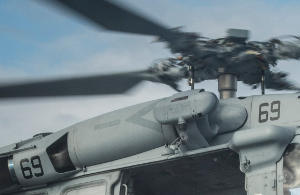
Although some small helicopters still use piston engines (also called reciprocating engines, similar to the ones used in cars and trucks), most now use gas turbines more like the jet engines on conventional airplanes. Turbine engines are smoother in operation (vibrating much less), more powerful, less mechanically complex, and more reliable. Some helicopters have a single engine mounted horizontally, underneath and just behind the rotor; most small Bell helicopters, for example, work like this. Others have one engine mounted either side of the rotor mast; military Seahawk and Apache helicopters are powered this way. Most modern choppers have turboshaft engines, which are similar to normal jet engines on airplanes. However, instead of squirting out a hot jet of exhaust gas that thrusts them forward, they use the energy from the burning gas to spin a central turbine and driveshaft that powers the transmission (the mechanism that allows the engine to power the rotors). Our main article on jet engines tells you more about how turbojet engines work.

Photo: Helicopter engine: Look under the rotor of this Seahawk helicopter. The long, gray tube between the two sets of numbers (“69”) is a turboshaft jet engine. There’s a second engine exactly the same on the other side. Photo by Trevor Kohlrus courtesy of US Navy.

Main rotor

The huge spinning rotor is the single most noticeable feature of any helicopter, but no chopper can get by with just one rotor. Why? A basic principle of physics called Newton’s third law of motion tells us that when a force (called an action) makes something move, another force, just as big (called a reaction), makes something else move in the opposite direction; action and reaction are equal and opposite is another way of putting it. As a helicopter rotor spins around (the action), the entire body of the craft tends to rotate somewhat more slowly in the opposite direction (the reaction). Left to its own devices, thistorque (turning force) would make a helicopter completely uncontrollable, so we have to counteract it in some way with what’s called counter-torque (a turning force in the opposite direction). One solution is to have a second large rotor spinning the other way. Sometimes this is mounted on the same mast as the first rotor (a design called a coaxial rotor); sometimes, as in the huge military Chinook helicopters, there’s a large rotor at either end of the craft (a design called a tandem rotor).

The counter-rotating front and rear rotors on a military Chinook helicopter.

Photo: Tandem rotor: This military Boeing CH-47 Chinook has one rotor at the front and one at the back and they spin in opposite directions to cancel one another’s torque. Photo by Tamara Vaughn courtesy of US Navy.

The blades of a helicopter’s main rotor come in three basic kinds that allow increasing amounts of movement as they spin around: they’re called rigid, semi-rigid, and fully articulated. As the name suggests, rigid blades are firmly attached to the rotor hub (the “wheel” to which the blades are fixed at the top of the spinning rotor mast) by a swiveling connection called a feathering hinge (or pitch hinge). This allows them to “feather” (swivel as they rotate, which, as we’ll discover in a moment, is how a helicopter steers). Semi-rigid blades have the same feathering hinge, but they also have ateetering hinge (or flapping hinge) that lets them flap up and down. Fully articulated blades can feather and flap, and they also have a third hinge (adrag hinge) that allows them to move slightly ahead of (“lead”) or behind (“lag”) their normal position. Each of these blade types has advantages and drawbacks.

Tail rotor

Helicopter tail rotor

Photo: The tail rotor of a Seahawk helicopter. The tail rotor is driven by a drive shaft running back from the main engines, parallel to the body of the helicopter. If you look closely, you’ll see that the blades of the rotor can be tilted by the pilot as they spin around, which generates more or less pushing force and gives the helicopter the ability to rotate on the spot as it hovers. Picture by James R. Evans courtesy of US Navy.

Apart from adding a second large rotor, another way to counteract the torque from the main rotor is by using a small, sideways-pointingpropeller called a tail rotor, powered by a driveshaft from the engine that runs through the tail end of the craft. Sometimes, for safety reasons, the tail rotor is built right inside the tail (a design called a fenestron or fan-tail). Another alternative is called a NOTAR® (“no tail rotor”), which uses a jet of air, fired through a vent on the tail, to counteract the main rotor torque instead. If a helicopter has a single main rotor blade, it has to have a tail rotor, fenestron, or NOTAR or it can’t fly safely; similarly, any damage to the tail rotor—such as a bird strike or missile hit—makes a copter dangerously uncontrollable and usually results in it crashing quite quickly afterward. Most helicopters have a vertical tail fin (pylon) that also helps to counteract some of the torque from the main rotor.

How does a helicopter hover and steer?

A helicopter’s rotors are ingenious things that allow it to hover in mid-air or steer in any direction. The pilot has five basic movement and steering controls: two hand levers called the collective and cyclic pitch, a throttle, and two foot pedals. Most maneuvers that a pilot executes involve a complex interplay between these different controls, which is why flying a helicopter requires such skill and concentration.

Hovering

As they start to spin around, the airfoils on the rotor blades generate lift that overcomes the weight of the craft, pushing it up into the air. If the lift is greater than the weight, the helicopter climbs; if it’s less than the weight, the helicopter falls. When the lift and the weight are exactly equal, the helicopter hovers in mid-air. The pilot can make the rotor blades generate more or less lift using a control called the collective pitch (or “collective”), which increases or decreases the angle (“pitch”) that all the blades make to the oncoming air as they spin around. For takeoff, the blades need to make a steep angle to generate maximum lift.

How a helicopter lifts and steers: collective and cyclic pitch compared.

How does that happen? As we’ve already seen, the main rotor is connected to the hub at the top of the mast by a feathering hinge that allows each blade to swivel as it spins, so it makes a steeper or shallower angle to the oncoming air. The blades have short vertical rods (pitch links) attached to them that are connected to a rotating metal disc called a swash plate, a bit lower down the mast. This swash plate slides on bearings around a second, similar plate directly underneath that doesn’t rotate. When the pilot moves the collective one way, both swash plates move upward, pushing up on the pitch links that tilt the rotor blades to a steeper angle. Moving the collective the other way moves the swash plates back down, pulling on the pitch links and tilting the blades to a shallower angle.

At the end of the collective, there’s a throttle connected by a cable to the engine. This is like the accelerator of a car or the throttle of a motorbike, increasing or decreasing the engine speed so the rotor makes more or less lift.

Artwork: How a helicopter hovers and steers: Top drawing: The collective pitch control changes the angle (or pitch) of each of the rotor blades by the same amount at the same time (green arrows)—in other words, collectively. If the blades make a steeper angle, they generate more lift so the entire craft moves straight upward (orange arrow). Bottom drawing: The cyclic pitch control changes the angle of selective rotor blades as they spin, so (in this case) whichever blade is on the left always produces slightly more lift, while the opposite blade (shown here on the right) always produces slightly less lift. That means more lift is produced on the left side of the helicopter, so the overall lift (orange arrow) is tilted to the right, steering the entire helicopter in that direction.

Steering

The rotors also provide the steering for a helicopter by making more lift on one side than the other. They do this by swiveling back and forth (feathering) as they rotate, so, for example, they make a steeper angle when they’re on the left side of the craft than when they’re on the right. That means they generate more lift on the left, tilting the craft over to the right and steering it in that direction. The pilot steers like this using a second lever called thecyclic pitch (also known as the “cyclic stick” or just “cyclic”), similar to a joystick, which makes the blades swivel as they cycle around. The ingenious swash plate mechanism translates the pilot’s movements into appropriate movements of the rotor blades. Suppose the pilot wants to fly to the right. First, she moves the cyclic to the right, and a system of connected levers makes the two swash plates tilt to the right as well. This makes the rotor blades tilt to a steep angle when they’re on the left and a shallow angle when they’re on the right, so the rotor produces more lift on the left hand side, steering the craft to the right.

<p”>How the tilting swash plate in a helicopter steers it from side to side.Artwork: How the swash plate steers a helicopter. In the center, you can see a simplified view of the swash plate mechanism. There are two discs at the top of the rotor mast, an upper one (red) that rotates on ball bearings (orange) around a lower one (blue) that doesn’t rotate at all. Four pitch links (green) connect the upper swash plate to the rotor blades. Now suppose you want to fly to the right. You tilt the cyclic in that direction. That tilts both swash plates over to the right. As the rotor blades rotate, the tilted swash plates force the pitch links up when they’re on the left and down when they’re on the right. That makes each rotor blade tilt to a steeper angle when it’s on the left and a shallower angle when it’s on the right. This produces more lift on the left, steering the chopper to the right.

The pilot can also steer the nose of a helicopter in a certain direction using a pair of foot controls, known asantitorque pedals, which change the pitch of the tail rotor blades so they make more or less sideways thrust than in normal straight flight. That makes the entire craft rotate slowly clockwise or counterclockwise so it heads in a different direction. On tandem rotor helicopters like the Chinook, which have no tail rotor, the foot pedals tilt the swashplates for the front and back rotors in opposite ways, steering the craft accordingly.

</p”>

How helicopter rotors work

Everyone knows a helicopter’s rotors rotate (that’s why they’re called rotors). But the really clever thing about them is that the blades can swivel back and forth as they turn around—and that requires some amazingly intricate machinery.

It’s easy to mimic a helicopter with your arms and your body’s hidden structure makes the movements seem easy. Stand up with your arms outstretched horizontally. Rotate your whole body slowly on the spot. As you’re turning around, swivel your arms at the shoulders. That’s roughly what a helicopter does with its blades, except that it does it about 3–4 times each second as the blades are spinning round! Here are the main bits that make it work:

The main parts of a helicopter rotor and the engine that powers it

  1. The blades are shaped like airfoils (airplane wings with a curved profile) so they generate lift as they spin.
  2. Each blade can swivel about a feathering hinge as it spins.
  3. Vertical pitch links push the blades up and down, making them swivel as they rotate. The pitch links move up and down according to the angle of the swash plates.
  4. The rotor mast (a central axle connected to the engine by the transmission) makes the entire blade assembly rotate.
  5. The rotor hub cap (above the rotors) helps to reduce aerodynamic drag.
  6. There are two turbo-shaft jet engines, one on either side of the rotors. If one engine fails, there should still be enough power from the other engine to land the helicopter safely.

Photo: Top: A US Navy engineer checks the rotor assembly on a Seahawk helicopter. Picture by Kathaleen A. Knowles courtesy of US Navy with annotations by Explain that Stuff. Bottom: An engineer repairs the amazingly intricate and complex rotor mechanism of a Seahawk, viewed here from directly above. The engines are the two open cones on either side. You can also see two of the rotor blades folded back along the fuselage (and pointing upward in this picture), which means the Seahawk can be parked on aircraft carriers in much less space. Photo by Oliver Cole courtesy of US Navy.

Seahawk helicopter rotor seen from above

How Sikorsky designed the modern helicopter rotor

All this sounds ingenious—and it is! The person who made it possible was brilliant Russian-born inventor Igor Sikorsky. Here are two of his original helicopter design drawings, taken from the patent for a Direct Lift Aircraft (helicopter) he filed in June 1931:

Igor Sikorsky helicopter patent US#1,994,488 filed June 27, 1931 showing details of the rotor blade mechanism.

Notice how similar the mechanism is to what we find on a modern helicopter? The patent is extremely detailed and quite complex (you can check it out for yourself), so I’ve removed most of the labels and numbers and highlighted just a few key features:

  1. There’s an aileron at the end of each rotor blade, shown in orange.
  2. The ailerons can be tilted (as they rotate) by the blue rods.
  3. There are two main rotor blades (which Sikorsky referred to collectively as the “lift propeller.”
  4. The entire rotor blades can swivel on the green rods and can also be tilted as they rotate.
  5. The main rotor blade rotates around a central hub (yellow) with an engine beneath it.
  6. A single engine powers both the main rotor blade and the tail rotor. One of Sikorsky’s key innovations was to produce a helicopter that needed only one main rotor blade, with a tail rotor to balance it, for reasons discussed below. As Sikorsky noted in his patent, having only one rotor means a helicopter is “light in weight, simple to construct, and cheap to produce”—three powerful advantages over earlier designs!

Artwork: Igor Sikorsky’s original patent drawings, with colors and annotations added for clarity. From US Patent #1,994,488: Direct Lift Aircraft, courtesy of US Patent and Trademark Office.

Advantages and disadvantages of helicopters

Harrier with swiveling engine nozzle labeled

Choppers have lots of advantages over planes. You don’t need a runway, for starters, or big wings, and you can operate helicopters more easily from ships. From the center of a city to the middle of a jungle, you can take off or land more or less anywhere. You can pause, mid-flight, to rescue someone, pick up a load, or drop it off with a winch. Admittedly, you can’t usually fly as fast or as far as a plane, or carry as many people or as much cargo, but you have much more flexibility in where you can go.

Photo: Alternatives to a helicopter#1: Vertical/Short Takeoff and Landing (V/STOL) aircraft, like the famous Harrier, shown here, try to combine the maneuverability of a helicopter with the speed of a plane. A Harrier can hover because, unlike a traditional jet engine, it has four extra nozzles on the side that can swivel around to direct the engine’s exhaust gases straight downward. Picture by Staci Bitzer courtesy of US Navy.

Unfortunately, this versatility comes at a price: helicopters with spinning rotors are mechanically more complex than planes with static wings, more prone to failure, need more maintenance, and are expensive to operate. Since you can fly a helicopter in all kinds of ways—it’s effectively several different flying craft all rolled into one—you might think piloting a chopper is automatically harder than flying a plane. But there’s no real comparison, because they’re two totally different things.

Three views of an osprey tilt rotor helicopter: flying forwards, coming in to land, and with rotors folded.

Photos: Alternatives to a helicopter#2: Bell Boeing’s V-22 Osprey has huge rotors at the front that can be tilted to point upward (like a helicopter) or forward (like a plane), combining the advantages of both in a single aircraft. Photos (left to right) by Andy M. Kin, Oscar Espinoza, and Zachary L. Borden, all courtesy of US Navy.

A brief history of helicopters

  • 400BCE: A Chinese book reveals how to make a “flying top” helicopter toy using spinning feathers attached to the end of a stick. You spin the stick quickly between your hands, hurl it into the air, and the feathers make it fly.
  • 1483: Italian inventor Leonardo da Vinci (1452–1519) designs a helicopter with corkscrew-shaped propeller blades to pull it up through the air. He doesn’t build it, however.
  • 1754: Russian engineer Mikhail Lomonosov (1711–1765) builds a small working model showing how a gear mechanism can drive a pair of coaxial, counter-rotating helicopter blades.
  • 1796: British aircraft pioneer Sir George Cayley (1773–1857) builds spring- and elastic-powered models of helicopters that fly to impressive heights (tens of meters). Later, in 1843, he sketches plans for a full-scale helicopter with two rotors, but the steam engines available at that time are much too heavy to power it.
  • 1880s: American inventor genius Thomas Edison (1847–1931) experiments with model helicopters, including some driven by electricity, his favorite source of power.
  • 1901: Igor Sikorsky (1889–1972), a Russian aircraft engineer, builds himself a working model helicopter powered by a rubber band. It’s the beginning of a life’s obsession with helicopters—one that will change the world.
  • 1904: Frenchman Charles Richet (1850–1935) builds a small helicopter, but it doesn’t carry a pilot.
  • 1907. Frenchman Louis Breguet (1880–1955), a student of Charles Richet, and his brother build a quadrotor helicopter (the Breguet-Richet gyroplane) with a rotor at each corner. It can fly about a meter off the ground for a minute or so at a time. Later the same year, another Frenchman, Paul Cornu (1881-1944), builds a small helicopter that can lift off for about 20 seconds.
  • 1916: Austrian aerodynamic genius Theodore von Kármán (1881–1963) helps to design a helicopter called the Petróczy, Kármán and Žurovec-1 (PKZ-1), driven by an electric motor, that proves powerful enough to lift three men.
  • 1920: Spaniard Juan de la Cierva (1895–1936) invents the autogyro, a small, flying airplane with a rotor on top.
  • 1931: After many years of experimenting, Igor Sikorsky designs and patents a practical, working helicopter. He finally builds and flies a version of it, the VS-300, in 1939.
  • 1942: Sikorsky’s R-4 becomes the world’s first mass-produced helicopter.
  • 1950–1953: Helicopters demonstrate their true military potential for the first time during the Korean War.
  • 1951: Charles Kaman builds the K-225, the first gas-turbine engined helicopter. Three years later, he builds the first twin-turbine helicopter, the HTK-1, for the US Navy.
  • 1961: Boeing’s fast, cargo-carrying tandem rotor CH-47 Chinook helicopter makes its maiden flight (entering production the following year). It can manage loads of up to 10 tonnes.
  • 1964: Frenchman Paul Fabre of Sud Aviation develops the fenestron.
  • 1967: Two Sikorsky S-61R helicopters make the first ever non-stop, transatlantic flight from New York City to Paris, France in a time of 30 hours 46 minutes.
  • 1981: NOTAR® (no tail rotor) is tested for the first time on a Hughes OH-6A helicopter.
  • 1988: Bell-Boeing begins production of its V-22 Osprey, a tilt-rotor aircraft that can take off like a helicopter but fly like a plane.
  • 1989: The McDonald Douglas 520N, the first mass-produced NOTAR® helicopter, makes its maiden flight on December 28, 1989.

Wednesday, 19 July 2017

Ask us, What do you Want to know?

This is a contact page with some basic contact information and a contact form. [contact-form]


Contact Form

Your name:

Your email:

Your message:


Thursday, 13 July 2017

Life after dead of a Buddhist Monk

Dashi-Dorzho Itigilov (Russian: Даши-Доржо Итигэлов; Buryat: Этигэлэй Дашадоржо; 1852–1927) was a BuryatBuddhist lama of the Tibetan Buddhisttradition, best known for the lifelike state of his dead body, which is reported not to be subject to macroscopic decay.

Dashi Dorzho Itigilov
Itigelov.jpg
BornMay 13, 1852
Chita, Zabaykalsky KraiRussian Empire
DiedJune 15, 1927 (aged 75)
CitizenshipRussian

BiographyEdit

Itigilov was born in 1852 and began his religious education at the age of sixteen years. He studied at the Anninsky Datsan (a Buddhist teaching monastery in Buryatia, of which only ruins remain), earning diplomas in medicine and philosophy. At that time he wrote an encyclopedia of pharmacology.

In 1911, he was appointed the twelfth Pandido Khambo Lama (as the head of Russian Buryat Buddhists is styled), at which post he inaugurated the period of a Buddhist revival among Buryats. Between 1913 and 1917, Itigilov was prominent in the spiritual life of Imperial Russia. He took part in the Tercentenary celebrations of the House of Romanovand opened the Datsan Gunzechoinei, the first Buddhist temple in St. PetersburgThe tsar had him invested with the Order of St. Stanislas on March nineteenth, 1917.[citation needed]

During the First World War Itigilov presided over the society of “Buryat brothers”, an organization helping the Russian army with money, provisions, clothes, and medicaments. He also helped set up a number of hospitals, with lama doctors helping wounded soldiers. For his charitable activities Itigilov was awarded the Order of St. Anna.

In 1926 Itigilov advised the Buddhist monks to leave Russia, since “the red teaching was coming to land”, himself choosing to remain in the country. A year later, aged seventy-five years, he asked other lamas to begin meditation ceremonies and funeral rites, since he said he was about to die. Lamas did not want to perform this meditation because Itigilov was still alive. As a result, Itigilov began to meditate alone until other lamas joined him and he soon ceased to breathe.

After deathEdit

Itigilov left a testament asking to be buried as he was at the time of his death, sitting in lotus posture. According to his wishes, his body was put into a pine box and interred at a bumkhan (a graveyard for the lama burials) in the locality of Khukhe-Zurkhen (Dark-blue Heart in Buryat language). One of the testament clauses stipulated that his body should be exhumed by other monks within several years.

The exhumed body of Itigilov

In 1955 and in 1973, Itigilov’s body was examined by Buddhist monks, who were astonished to observe no signs of decay. They were too reluctant to divulge their finding to the anti-religious authorities of the Soviet Union and the body remained in situ until 2002.

On September 11, 2002, Itigilov’s body was eventually exhumed in the presence of the leaders of the Buddhist Traditional Sangha of Russia. The body was transferred to Ivolginsky datsan (a residence of today’s Hambo Lama) where it was closely examined by monks as well as by scientists and pathologists. The official statement was issued about the body – it was “in the condition of someone who had died 36 hours ago”, very well preserved, without any signs of decay, with whole muscles and inner tissue, soft joints and skin.[1]

A report by Al Jazeera states that the body had been preserved by being packed in salt[2] and shows recent footage of the body being removed from this salt, although the reporter was not clear about when the salt was first applied.

The Buddhist monks approach him as a living person and shake hands with him. Some devotees even claim that Itigilov is still alive, only immersed in a hibernation- or nirvana-like state.

On April twenty-third, 2003, the Buddhist conference recognized the body of Dashi-Dorzho Itigilov as one of the sacred Buddhist objects of Russia. At that time, they laid the foundation stone for a temple entitled Itigel Khambyn ordon and consecrated to Dashi-Dorzho Itigilov. As of 2005, Itigilov’s body was kept out of doors, in contact with other people, without preserving any temperature or humidity regimens.

In April 2013, Vladimir Putin went to Buryatia to “hold a conversation” with Itigilov and other lamas.[3]


List of particles

Elementary particles are particles with no measurable internal structure; that is, they are not composed of other particles. They are the fundamental objects of quantum field theory. Many families and sub-families of elementary particles exist. Elementary particles are classified according to their spin. Fermions have half-integer spin while bosons have integer spin. All the particles of the Standard Model have been experimentally observed, recently including the Higgs boson.[1][2]

Fermions

Fermions are one of the two fundamental classes of particles, the other being bosons. Fermion particles are described by Fermi–Dirac statistics and have quantum numbers described by the Pauli exclusion principle. They include the quarks and leptons, as well as any composite particles consisting of an odd number of these, such as all baryons and many atoms and nuclei.

Fermions have half-integer spin; for all known elementary fermions this is 12. All known fermions, except neutrinos, are also Dirac fermions; that is, each known fermion has its own distinct antiparticle. It is not known whether the neutrino is a Dirac fermion or a Majorana fermion.[3] Fermions are the basic building blocks of all matter. They are classified according to whether they interact via the color force or not. In the Standard Model, there are 12 types of elementary fermions: six quarks and six leptons.

Quarks

Quarks are the fundamental constituents of hadrons and interact via the strong interaction. Quarks are the only known carriers of fractional charge, but because they combine in groups of three (baryons) or in pairs of one quark and one antiquark (mesons), only integer charge is observed in nature. Their respective antiparticles are the antiquarks, which are identical except that they carry the opposite electric charge (for example the up quark carries charge +23, while the up antiquark carries charge −23), color charge, and baryon number. There are six flavors of quarks; the three positively charged quarks are called “up-type quarks” and the three negatively charged quarks are called “down-type quarks”.

Quarks
NameSymbolAntiparticleCharge
(e)
Mass (MeV/c2) [4]Spin
upuu+232.2+0.6
−0.4
½
downdd134.6+0.5
−0.4
½
charmcc+231280±30½
strangess1396+8
−4
½
toptt+23173,100±600½
bottombb134,180+40
−30
½

Leptons

Leptons do not interact via the strong interaction. Their respective antiparticles are the antileptons which are identical, except for the fact that they carry the opposite electric charge and lepton number. The antiparticle of an electron is an antielectron, which is nearly always called a “positron” for historical reasons. There are six leptons in total; the three charged leptons are called “electron-like leptons”, while the neutral leptons are called “neutrinos“. Neutrinos are known to oscillate, so that neutrinos of definite flavor do not have definite mass, rather they exist in a superposition of mass eigenstates. The hypothetical heavy right-handed neutrino, called a “sterile neutrino“, has been left off the list.

Leptons
NameSymbolAntiparticleCharge
(e)
Mass (MeV/c2) [4]
Electrone−e+−10.511[note 1]
Electron neutrinoν
e
ν
e
0< 0.0000022
Muonμ−μ+−1105.7[note 2]
Muon neutrinoν
μ
ν
μ
0< 0.170
Tauτ−τ+−11,776.86±0.12
Tau neutrinoν
τ
ν
τ
0< 15.5
  1. Jump up^ The electron mass is known very precisely as 0.5109989461±0.0000000031 MeV
  2. Jump up^ The muon mass known very precisely as 105.6583745±0.0000024 MeV

Bosons

Bosons are one of the two fundamental classes of particles, the other being fermions. Bosons are characterized by Bose–Einstein statistics and all have integer spins. Bosons may be either elementary, like photonsand gluons, or composite, like mesons.

According to the Standard Model the elementary bosons are:

NameSymbolAntiparticleCharge (e)SpinMass (GeV/c2) [4]Interaction mediatedExistence
PhotonγSelf010ElectromagnetismConfirmed
W bosonW−W+−1180.385±0.015Weak interactionConfirmed
Z bosonZSelf0191.1875±0.0021Weak interactionConfirmed
GluongSelf010Strong interactionConfirmed
Higgs bosonH0Self00125.09±0.24MassConfirmed
GravitonGSelf020GravitationUnconfirmed

Elementary bosons responsible for the four fundamental forces of nature are called force particles (gauge bosons). Strong interaction is mediated by the gluon, weak interaction is mediated by the W and Z bosons, and it is sometimes hypothetized that gravitation is mediated by the graviton, although it is not predicted by the Standard Model but by other theories in the framework of quantum field theory.

The Higgs boson is postulated by the electroweak theory primarily to explain the origin of particle masses. In a process known as the “Higgs mechanism“, the Higgs boson and the other gauge bosons in the Standard Model acquire mass via spontaneous symmetry breaking of the SU(2) gauge symmetry. The Minimal Supersymmetric Standard Model (MSSM) predicts several Higgs bosons. A new particle expected to be the Higgs boson was observed at the CERN/LHC on March 14, 2013, around the energy of 126.5 GeV with an accuracy of close to five sigma (99.9999%, which is accepted as definitive). The Higgs mechanism giving mass to other particles has not been observed yet.

Hypothetical particles

Supersymmetric theories predict the existence of more particles, none of which have been confirmed experimentally as of 2016:

Superpartners (Sparticles)
SuperpartnerSuperpartner ofSpinNotes
neutralinoneutral bosons12The neutralinos are superpositions of the superpartners of neutral Standard Model bosons: neutral Higgs boson, Z boson and photon.
The lightest neutralino is a leading candidate for dark matter.
The MSSM predicts four neutralinos.
charginocharged bosons12The charginos are superpositions of the superpartners of charged Standard Model bosons: charged Higgs boson and W boson.
The MSSM predicts two pairs of charginos.
photinophoton12Mixing with zino and neutral Higgsinos for neutralinos.
wino, zinoW± and Z0 bosons12The charged wino mixing with the charged Higgsino for charginos, for the zino see line above.
HiggsinoHiggs boson0For supersymmetry there is a need for several Higgs bosons, neutral and charged, according with their superpartners.
gluinogluon12Eight gluons and eight gluinos.
gravitinograviton32Predicted by supergravity (SUGRA). The graviton is hypothetical, too – see next table.
sleptonsleptons0The superpartners of the leptons (electron, muon, tau) and the neutrinos.
sneutrinoneutrino0Introduced by many extensions of the Standard Supermodel, and may be needed to explain the LSND results.
A special role has the sterile sneutrino, the supersymmetric counterpart of the hypothetical right-handed neutrino, called the “sterile neutrino“.
squarksquarks0The stop squark (superpartner of the top quark) is thought to have a low mass and is often the subject of experimental searches.

Note: just as the photon, Z boson and W± bosons are superpositions of the B0, W0, W1, and W2 fields – the photino, zino, and wino± are superpositions of the bino0, wino0, wino1, and wino2 by definition.
No matter if one uses the original gauginos or this superpositions as a basis, the only predicted physical particles are neutralinos and charginos as a superposition of them together with the Higgsinos.

Other theories predict the existence of additional bosons:

Other hypothetical bosons and fermions
NameSpinNotes
graviton2Has been proposed to mediate gravity in theories of quantum gravity.
dual graviton2Has been hypothesized as dual of graviton under electric-magnetic duality insupergravity.
graviscalar0Also known as “radion”.
graviphoton1Also known as “gravivector”.[5]
axion0A pseudoscalar particle introduced in Peccei–Quinn theory to solve the strong-CP problem.
axino12Superpartner of the axion. Forms, together with the saxion and axion, asupermultiplet in supersymmetric extensions of Peccei–Quinn theory.
saxion0
branon ?Predicted in brane world models.
dilaton0Predicted in some string theories.
dilatino12Superpartner of the dilaton.
X and Y bosons1These leptoquarks are predicted by GUT theories to be heavier equivalents of the W and Z.
W’ and Z’ bosons1
magnetic photon ?A. Salam (1966). “Magnetic monopole and two photon theories of C-violation.” Physics Letters 22 (5): 683–684.
majoron0Predicted to understand neutrino masses by the seesaw mechanism.
majorana fermion12 ; 32 ?…gluino, neutralino, or other – is its own antiparticle.
chameleon0a possible candidate for dark energy and dark matter, and may contribute tocosmic inflation.

Mirror particles are predicted by theories that restore parity symmetry.

Magnetic monopole” is a generic name for particles with non-zero magnetic charge. They are predicted by some GUTs.

Tachyon” is a generic name for hypothetical particles that travel faster than the speed of light (and so paradoxically experience time in reverse due to inversal of Theory of relativity) and have an imaginary rest mass.

Preons were suggested as subparticles of quarks and leptons, but modern collider experiments have all but ruled out their existence.

Kaluza–Klein towers of particles are predicted by some models of extra dimensions. The extra-dimensional momentum is manifested as extra mass in four-dimensional spacetime.

Composite particles

Hadrons

Hadrons are defined as strongly interacting composite particles. Hadrons are either:

  • Composite fermions (especially 3 quarks), in which case they are called baryons.
  • Composite bosons (especially 2 quarks), in which case they are called mesons.

Quark models, first proposed in 1964 independently by Murray Gell-Mann and George Zweig (who called quarks “aces”), describe the known hadrons as composed of valence quarks and/or antiquarks, tightly bound by the color force, which is mediated by gluons. A “sea” of virtual quark-antiquark pairs is also present in each hadron.

Baryons[edit]

A combination of three u, d or s-quarks with a total spin of 32 form the so-called “baryon decuplet”.

Proton quark structure: 2 up quarks and 1 down quark. The gluon tubes or flux tubes are now known to be Y shaped.

Ordinary baryons (composite fermions) contain three valence quarks or three valence antiquarks each.

  • Nucleons are the fermionic constituents of normal atomic nuclei:
    • Protons, composed of two up and one down quark (uud)
    • Neutrons, composed of two down and one up quark (ddu)
  • Hyperons, such as the Λ, Σ, Ξ, and Ω particles, which contain one or more strange quarks, are short-lived and heavier than nucleons. Although not normally present in atomic nuclei, they can appear in short-lived hypernuclei.
  • A number of charmed and bottom baryons have also been observed.

Some hints at the existence of exotic baryons have been found recently; however, negative results have also been reported. Their existence is uncertain.

  • Pentaquarks consist of four valence quarks and one valence antiquark.

Mesons

Mesons of spin 0 form a nonet

Ordinary mesons are made up of a valence quark and a valence antiquark. Because mesons have spin of 0 or 1 and are not themselves elementary particles, they are “composite”bosons. Examples of mesons include the pion, kaon, and the J/ψ. In quantum hydrodynamic models, mesons mediate the residual strong force between nucleons.

At one time or another, positive signatures have been reported for all of the following exotic mesons but their existences have yet to be confirmed.

  • A tetraquark consists of two valence quarks and two valence antiquarks;
  • A glueball is a bound state of gluons with no valence quarks;
  • Hybrid mesons consist of one or more valence quark-antiquark pairs and one or more real gluons.

Atomic nuclei

A semi-accurate depiction of the helium atom. In the nucleus, the protons are in red and neutrons are in purple. In reality, the nucleus is also spherically symmetrical.

Atomic nuclei consist of protons and neutrons. Each type of nucleus contains a specific number of protons and a specific number of neutrons, and is called a “nuclide” or “isotope“.Nuclear reactions can change one nuclide into another. See table of nuclides for a complete list of isotopes.

Atoms

Atoms are the smallest neutral particles into which matter can be divided by chemical reactions. An atom consists of a small, heavy nucleus surrounded by a relatively large, light cloud of electrons. Each type of atom corresponds to a specific chemical element. To date, 118 elements have been discovered or created.

The atomic nucleus consists of protons and neutrons. Protons and neutrons are, in turn, made of quarks.

Molecules

Molecules are the smallest particles into which a non-elemental substance can be divided while maintaining the physical properties of the substance. Each type of molecule corresponds to a specific chemical compound. Molecules are a composite of two or more atoms. See list of compounds for a list of molecules. A molecule is generally combined in a fixed proportion. It is the most basic unit of matter and is homogenous.

Condensed matter

The field equations of condensed matter physics are remarkably similar to those of high energy particle physics. As a result, much of the theory of particle physics applies to condensed matter physics as well; in particular, there are a selection of field excitations, called quasi-particles, that can be created and explored. These include:

Other

  • An anyon is a generalization of fermion and boson in two-dimensional systems like sheets of graphene that obeys braid statistics.
  • A plekton is a theoretical kind of particle discussed as a generalization of the braid statistics of the anyon to dimension > 2.
  • A WIMP (weakly interacting massive particle) is any one of a number of particles that might explain dark matter (such as the neutralino or the axion).
  • The pomeron, used to explain the elastic scattering of hadrons and the location of Regge poles in Regge theory.
  • The skyrmion, a topological solution of the pion field, used to model the low-energy properties of the nucleon, such as the axial vector current coupling and the mass.
  • A genon is a particle existing in a closed timelike world line where spacetime is curled as in a Frank Tipler or Ronald Mallett time machine.
  • A goldstone boson is a massless excitation of a field that has been spontaneously broken. The pions are quasi-goldstone bosons (quasi- because they are not exactly massless) of the broken chiral isospinsymmetry of quantum chromodynamics.
  • A goldstino is a goldstone fermion produced by the spontaneous breaking of supersymmetry.
  • An instanton is a field configuration which is a local minimum of the Euclidean action. Instantons are used in nonperturbative calculations of tunneling rates.
  • A dyon is a hypothetical particle with both electric and magnetic charges.
  • A geon is an electromagnetic or gravitational wave which is held together in a confined region by the gravitational attraction of its own field of energy.
  • An inflaton is the generic name for an unidentified scalar particle responsible for the cosmic inflation.
  • A spurion is the name given to a “particle” inserted mathematically into an isospin-violating decay in order to analyze it as though it conserved isospin.
  • What is called “true muonium”, a bound state of a muon and an antimuon, is a theoretical exotic atom which has never been observed.
  • A diphoton A resonance particle formed from two identical photons.
  • An ion (a charged atom or molecule) is either an anion or a cation.

Classification by speed

  • A tardyon or bradyon travels slower than light and has a non-zero rest mass.
  • A luxon travels at the speed of light and has no rest mass.
  • A tachyon (mentioned above) is a hypothetical particle that travels faster than the speed of light and has an imaginary rest mass.