Energy is the capacity to do work and is required for life processes. An energy resource is something that can produce heat, power life, move objects, or produce electricity. Matter that stores energy is called fuel. Human energy consumption has grown steadily .throughout human history. Early humans had modest energy requirements, mostly food and fuel for fires to cook and keep warm. In today's society, humans consume as much as 110 times as much energy per person as early humans. Most of the energy we use today comes from fossil fuels (stored solar energy). But fossils fuels have a disadvantage in that they are non-renewable on a human time scale, and cause other potentially harmful effects on the environment. In any event, the exploitation of all energy sources (with the possible exception of direct solar energy used for heating), ultimately rely on materials on planet Earth.
First questions we want to answer in this discussion:
What sources of Energy are available?
How do the energy sources rely on resources available on Earth?
Which energy sources are renewable on a human time scale?
Since fossil fuels (oil, natural gas, coal) are our main source of energy, how are they formed, how do we find them and exploit them?
What is the future for our energy needs?
Energy Sources
There are 5 fundamental sources of energy:
Nuclear fusion in the Sun (solar energy)
Gravity generated by the Earth & Moon.
Nuclear fission reactions.
Energy in the interior of the Earth.
Energy stored in chemical bonds.
Basically, in this post, I am going to talk about Solar Energy.
Solar Energy
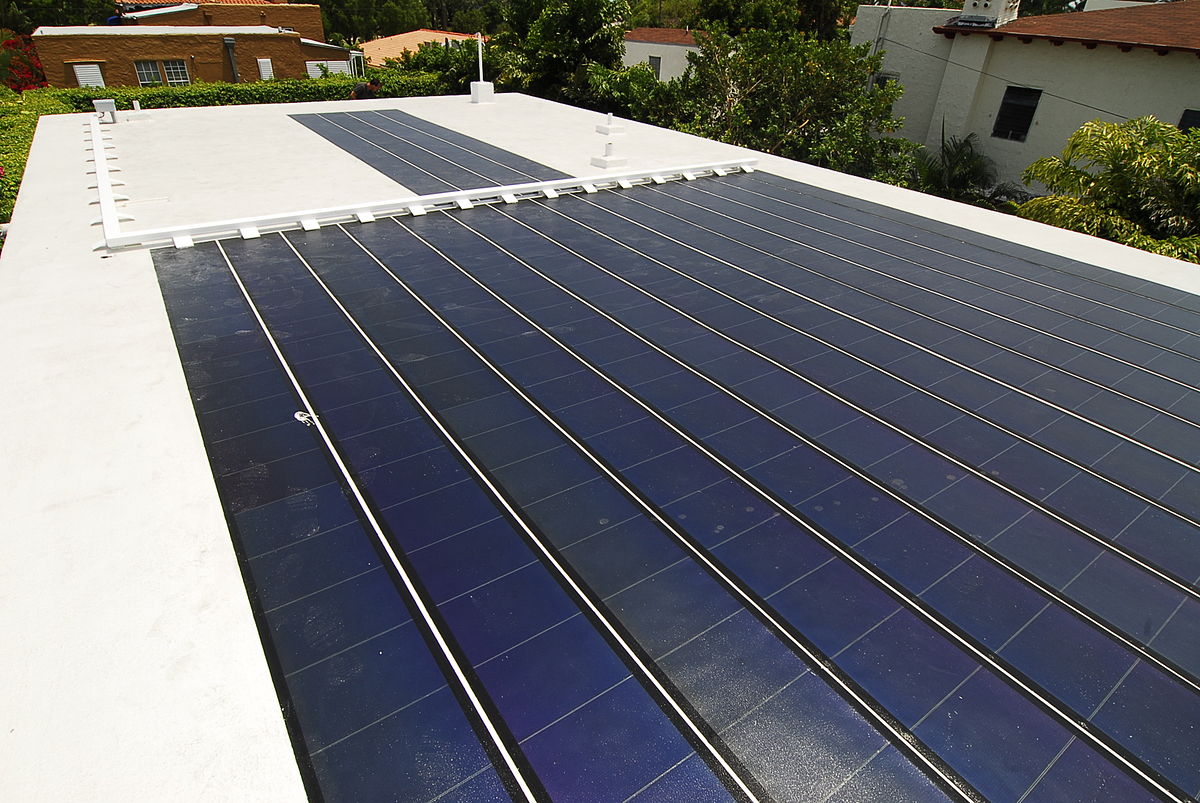
Solar Energy arrives from the Sun by electromagnetic radiation. It can be used directly for heat and converted to electricity for other uses. It is a nearly unlimited source, it is renewable, and largely, non-polluting.
Solar cell
A solar cell, or photovoltaic cell, is an electrical device that converts the energy of light directly into electricity by the photovoltaic effect, which is a physical and chemical phenomenon. It is a form of photoelectric cell, defined as a device whose electrical characteristics, such as current, voltage, or resistance, vary when exposed to light. Individual solar cell devices can be combined to form modules, otherwise known as solar panels. In basic terms, a single junction silicon solar cell can produce a maximum open-circuit voltage of approximately 0.5 to 0.6 volts.
Solar cells are described as being photovoltaic, irrespective of whether the source is sunlight or artificial light. They are used as a photodetector (for example infrared detectors), detecting light or other electromagnetic radiation near the visible range, or measuring light intensity.
The operation of a photovoltaic (PV) cell requires three basic attributes:
The absorption of light, generating either electron-hole pairs or excitons.
The separation of charge carriers of opposite types.
The separate extraction of those carriers to an external circuit.
In contrast, a solar thermal collector supplies heat by absorbing sunlight, for the purpose of either direct heating or indirect electrical power generation from heat. A "photoelectrolytic cell" (photoelectrochemical cell), on the other hand, refers either to a type of photovoltaic cell (like that developed by Edmond Becquerel and modern dye-sensitized solar cells) or to a device that splits water directly into hydrogen and oxygen using only solar illumination.
Brief History of Solar Cell
The photovoltaic effect was experimentally demonstrated first by French physicist Edmond Becquerel. In 1839, at age 19, he built the world's first photovoltaic cell in his father's laboratory.
Willoughby Smith first described the "Effect of Light on Selenium during the passage of an Electric Current" in a 20 February 1873 issue of Nature. In 1883 Charles Fritts built the first solid-state photovoltaic cell by coating the semiconductor selenium with a thin layer of gold to form the junctions; the device was only around 1% efficient. Other milestones include:
1888 – Russian physicist Aleksandr Stoletov built the first cell based on the outer photoelectric effect discovered by Heinrich Hertz in 1887.
1905 – Albert Einstein proposed a new quantum theory of light and explained the photoelectric effect in a landmark paper, for which he received the Nobel Prize in Physics in 1921.
1941 – Vadim Lashkaryov discovered p-n-junctions in Cu2O and Ag2S protocells.
1946 – Russell Ohl patented the modern junction semiconductor solar cell,[8] while working on the series of advances that would lead to the transistor.
1954 – the first practical photovoltaic cell was publicly demonstrated at Bell Laboratories.[9] The inventors were Calvin Souther Fuller, Daryl Chapin, and Gerald Pearson.
1958 – solar cells gained prominence with their incorporation onto the Vanguard I satellite.
Price Reduce of Solar Cell
Adjusting for inflation, it cost $96 per watt for a solar module in the mid-1970s. Process improvements and a very large boost in production have brought that figure down 99%, to 68¢ per watt in 2016, according to data from Bloomberg New Energy Finance.
During the 1990s, polysilicon ("poly") cells became increasingly popular. These cells offer less efficiency than their monosilicon ("mono") counterparts, but they are grown in large vats that reduce cost. By the mid-2000s, poly was dominant in the low-cost panel market, but more recently the mono returned to widespread use.
Solar Energy Theory
The solar cell works in several steps:
Photons in sunlight hit the solar panel and are absorbed by semiconducting materials, such as silicon.
Electrons are excited from their current molecular/atomic orbital. Once excited an electron can either dissipate the energy as heat and return to its orbital or travel through the cell until it reaches an electrode. Current flows through the material to cancel the potential and this electricity is captured. The chemical bonds of the material are vital for this process to work, and usually, silicon is used in two layers, one layer being doped with boron, the other phosphorus. These layers have different chemical electric charges and subsequently both drive and direct the current of electrons.
An array of solar cells converts solar energy into a usable amount of direct current (DC) electricity.
An inverter can convert the power to alternating current (AC).
The most commonly known solar cell is configured as a large-area p–n junction made from silicon. Other possible solar cell types are organic solar cells, dye-sensitized solar cells, perovskite solar cells, quantum dot solar cells, etc. The illuminated side of a solar cell generally has a transparent conducting film for allowing light to enter into active material and to collect the generated charge carriers. Typically, films with high transmittance and high electrical conductance such as indium tin oxide, conducting polymers or conducting nanowire networks are used for the purpose.
Efficiency
Solar cell efficiency may be broken down into reflectance efficiency, thermodynamic efficiency, charge carrier separation efficiency and conductive efficiency. The overall efficiency is the product of these individual metrics.
The power conversion efficiency of a solar cell is a parameter which is defined by the fraction of incident power converted into electricity.
Single p–n junction crystalline silicon devices are now approaching the theoretical limiting power efficiency of 33.16%,[41] noted as the Shockley–Queisser limit in 1961. In the extreme, with an infinite number of layers, the corresponding limit is 86% using concentrated sunlight.[42]
In 2014, three companies broke the record of 25.6% for a silicon solar cell. Panasonic's was the most efficient.
In 2015, a 4-junction GaInP/GaAs//GaInAsP/GaInAs solar cell achieved a new laboratory record efficiency of 46.1 percent (concentration ratio of sunlight = 312) in a French-German collaboration between the Fraunhofer Institute for Solar Energy Systems (Fraunhofer ISE), CEA-LETI and SOITEC.
Materials
Solar cells are typically named after the semiconducting material they are made of. These materials must have certain characteristics in order to absorb sunlight. Some cells are designed to handle sunlight that reaches the Earth's surface, while others are optimized for use in space. Solar cells can be made of only one single layer of light-absorbing material (single-junction) or use multiple physical configurations (multi-junctions) to take advantage of various absorption and charge separation mechanisms.
Solar cells can be classified into first, second and third generation cells. The first generation cells—also called conventional, traditional or wafer-based cells—are made of crystalline silicon, the commercially predominant PV technology, that includes materials such as polysilicon and monocrystalline silicon. Second generation cells are thin film solar cells, that include amorphous silicon, CdTe and CIGS cells and are commercially significant in utility-scale photovoltaic power stations, building integrated photovoltaics or in small stand-alone power system. The third generation of solar cells includes a number of thin-film technologies often described as emerging photovoltaics—most of them have not yet been commercially applied and are still in the research or development phase. Many use organic materials, often organometallic compounds as well as inorganic substances. Despite the fact that their efficiencies had been low and the stability of the absorber material was often too short for commercial applications, there is a lot of research invested into these technologies as they promise to achieve the goal of producing low-cost, high-efficiency solar cells.
Crystalline silicon
Monocrystalline silicon
Epitaxial silicon
Polycrystalline silicon or multicrystalline silicon
Ribbon silicon
Mono-like-multi silicon (MLM)
Thin film
Cadmium Telluride
Copper indium gallium selenide
Silicon thin film
Gallium arsenide thin film
Multijunction cells
GaInP/Si dual-junction solar cells
Research in solar cells
Perovskite solar cells - Perovskite solar cells are solar cells that include a perovskite-structured material as the active layer.
Bifacial solar cells - With a transparent rear side, bifacial solar cells can absorb light from both the front and rear sides. Hence, they can produce more electricity than conventional monofacial solar cells.
Intermediate Band - Intermediate band photovoltaics in solar cell research provides methods for exceeding the Shockley–Queisser limit on the efficiency of a cell. It introduces an intermediate band (IB) energy level in between the valence and conduction bands. Theoretically, introducing an IB allows two photons with energy less than the bandgap to excite an electron from the valence band to the conduction band. This increases the induced photocurrent and thereby efficiency.
Liquid ink - In 2014, researchers at California NanoSystems Institute discovered using kesterite and perovskite improved electric power conversion efficiency for solar cells.
Upconversion and downconversion
Light-absorbing dye - Dye-sensitized solar cells (DSSCs) are made of low-cost materials and do not need elaborate manufacturing equipment so they can be made in a DIY fashion.
Quantum dots - Quantum dot solar cells (QDSCs) are based on the Gratzel cell or dye-sensitized solar cell architecture, but employ low bandgap semiconductornanoparticles, fabricated with crystallite sizes small enough to form quantum dots (such as CdS, CdSe, Sb 2S 3, PbS, etc.), instead of organic or organometallic dyes as light absorbers.
Upconversion and downconversion - Photon upconversion is the process of using two low-energy (e.g., infrared) photons to produce one higher energy photon; downconversion is the process of using one high energy photon (e.g.,, ultraviolet) to produce two lower energy photons. Either of these techniques could be used to produce higher efficiency solar cells by allowing solar photons to be more efficiently used. The difficulty, however, is that the conversion efficiency of existing phosphors exhibiting up- or down-conversion is low, and is typically narrow band.
Organic/polymer solar cells - Organic solar cells and polymer solar cells are built from thin films (typically 100 nm) of organic semiconductors.
Adaptive cells - Adaptive cells change their absorption/reflection characteristics depending to respond to environmental conditions. An adaptive material responds to the intensity and angle of the incident light. At the part of the cell where the light is most intense, the cell surface changes from reflective to adaptive, allowing the light to penetrate the cell. The other parts of the cell remain reflective increasing the retention of the absorbed light within the cell.
Surface texturing - Surface texturing is one of the techniques used to reduce optical losses to maximize light absorbed.
Encapsulation - Solar cells are commonly encapsulated in transparent polymeric resin to protect the delicate solar cell regions for coming into contact with moisture, dirt, ice, and other conditions expected either during operation or when used outdoors. The encapsulants are commonly made from polyvinyl acetate or glass.
For the next generation, Thin Film Solar Cell is being Developed.
Tin(II) sulfide is an interesting potential candidate for next-generation thin film solar cells. Currently, both Cadmium Telluride and CIGS (Copper Indium Gallium Sulfide) are used as p-type absorber layers, but they are formulated from toxic, scarce constituents.[8] Tin(II) sulfide, by contrast, is formed from cheap, earth-abundant elements, and is nontoxic. This material also has a high optical absorption coefficient, p-type conductivity, and a mid-range direct band gap of 1.3-1.4 eV, required electronic properties for this type of absorber layer.[9] Based on the detailed balance calculation using the material bandgap, the power conversion efficiency of a solar cell utilizing a tin(II) sulfide absorber layer could be as high as 32%, which is comparable to crystalline silicon.[10] Finally, Tin(II) sulfide is stable in both alkaline and acidic conditions.[11] All aforementioned characteristics suggest tin(II) sulfide as an interesting material to be used as a solar cell absorber layer.
At present, tin(II) sulfide thin films for use in photovoltaic cells are still in the research phase of development with power conversion efficiencies currently less than 5%.[12] Barriers for use include a low open circuit voltage and an inability to realize many of the above properties due to challenges in fabrication, but tin(II) sulfide still remains a promising material if these technical challenges are overcome.
THE UNIVERSE CONTAINS EVERYTHING that exists, from the tiniest subatomic particles to galactic superclusters (the largest structures known). No one knows how big the universe is, but astronomers estimate that it contains at least 125 billion galaxies, each comprising an average of 100 billion stars. The most widely accepted theory about the origin of the universe is the Big Bang theory, which states that the universe came into being in a huge explosion—the Big Bang—that took place between 10 and 20 billion years ago. The universe initially consisted of a very hot, dense fireball of expanding, cooling gas. After about one million years, the gas began to condense into localized clumps called protogalaxies. During the next five billion years, the protogalaxies continued condensing, forming galaxies in which stars were being born. Today, billions of years later, the universe as a whole is still expanding, although there are localized areas in which objects are held together by gravity; for example, many galaxies are found in clusters. The Big Bang theory is supported by the discovery of faint, cool background radiation coming evenly from all directions. This radiation is believed to be the remnant of the radiation produced by the Big Bang. Small “ripples” in the temperature of the cosmic background radiation are thought to be evidence of slight fluctuations in the density of the early universe, which resulted in the formation of galaxies. Astronomers do not yet know if the universe is “closed,” which means it will eventually stop expanding and begin to contract, or if it is “open,” which means it will continue expanding forever.
A Candle: The Flame — Its Sources — Structure — Mobility — Brightness.
I purpose, in return for the honour you do us by coming to see what are our proceedings here, to bring before you, in the course of these lectures, the Chemical History of a Candle. I have taken this subject on a former occasion; and were it left to my own will, I should prefer to repeat it almost every year — so abundant is the interest that attaches itself to the subject, so wonderful are the varieties of outlet which it offers into the various departments of philosophy. There is not a law under which any part of this universe is governed which does not come into play, and is touched upon in these phenomena. There is no better, there is no more open door by which you can enter into the study of natural philosophy, than by considering the physical phenomena of a candle. I trust, therefore, I shall not disappoint you in choosing this for my subject rather than any newer topic, which could not be better, were it even so good.
And before proceeding, let me say this also — that though our subject be so great, and our intention that of treating it honestly, seriously, and philosophically, yet I mean to pass away from all those who are seniors amongst us. I claim the privilege of speaking to juveniles as a juvenile myself. I have done so on former occasions — and, if you please, I shall do so again. And though I stand here with the knowledge of having the words I utter given to the world, yet that shall not deter me from speaking in the same familiar way to those whom I esteem nearest to me on this occasion.
And now, my boys and girls, I must first tell you of what candles are made. Some are great curiosities. I have here some bits of timber, branches of trees particularly famous for their burning. And here you see a piece of that very curious substance taken out of some of the bogs in Ireland, called candle-wood — a hard, strong, excellent wood, evidently fitted for good work as a resister of force, and yet withal burning so well that where it is found they make splinters of it, and torches, since it burns like a candle, and gives a very good light indeed. And in this wood we have one of the most beautiful illustrations of the general nature of a candle that I can possibly give. The fuel provided, the means of bringing that fuel to the place of chemical action, the regular and gradual supply of air to that place of action — heat and light — all produced by a little piece of wood of this kind, forming, in fact, a natural candle.
But we must speak of candles as they are in commerce. Here are a couple of candles commonly called dips. They are made of lengths of cotton cut off, hung up by a loop, dipped into melted tallow, taken out again and cooled, then redipped until there is an accumulation of tallow round the cotton. In order that you may have an idea of the various characters of these candles, you see these which I hold in my hand — they are very small, and very curious. They are, or were, the candles used by the miners in coal mines. In olden times the miner had to find his own candles; and it was supposed that a small candle would not so soon set fire to the fire-damp in the coal mines as a large one; and for that reason, as well as for economy’s sake, he had candles made of this sort — 20, 30, 40, or 60 to the pound. They have been replaced since then by the steel-mill, and then by the Davy-lamp, and other safety-lamps of various kinds. I have here a candle that was taken out of the Royal George1, it is said, by Colonel Pasley. It has been sunk in the sea for many years, subject to the action of salt water. It shews you how well candles may be preserved; for though it is cracked about and broken a good deal, yet, when lighted, it goes on burning regularly, and the tallow resumes its natural condition as soon as it is fused.
Mr. Field, of Lambeth, has supplied me abundantly with beautiful illustrations of the candle and its materials. I shall therefore now refer to them. And, first, there is the suet — the fat of the ox — Russian tallow, I believe, employed in the manufacture of these dips, which Gay Lussac, or some one who entrusted him with his knowledge, converted into that beautiful substance, stearin, which you see lying beside it. A candle, you know, is not now a greasy thing like an ordinary tallow candle, but a clean thing, and you may almost scrape off and pulverise the drops which fall from it without soiling anything. This is the process he adopted2:— The fat or tallow is first boiled with quick-lime, and made into a soap, and then the soap is decomposed by sulphuric acid, which takes away the lime, and leaves the fat rearranged as stearic acid, whilst a quantity of glycerin is produced at the same time. Glycerin — absolutely a sugar, or a substance similar to sugar — comes out of the tallow in this chemical change. The oil is then pressed out of it; and you see here this series of pressed cakes, shewing how beautifully the impurities are carried out by the oily part as the pressure goes on increasing, and at last you have left that substance which is melted, and cast into candles as here represented. The candle I have in my hand is a stearin candle, made of stearin from tallow in the way I have told you. Then here is a sperm candle, which comes from the purified oil of the spermaceti whale. Here also are yellow bees-wax and refined bees-wax, from which candles are made. Here, too, is that curious substance called paraffin, and some paraffin candles made of paraffin obtained from the bogs of Ireland. I have here also a substance brought from Japan, since we have forced an entrance into that out-of-the-way place — a sort of wax which a kind friend has sent me, and which forms a new material for the manufacture of candles.
And how are these candles made? I have told you about dips, and I will shew you how moulds are made. Let us imagine any of these candles to be made of materials which can be cast. “Cast!” you say. “Why, a candle is a thing that melts; and surely if you can melt it, you can cast it.” Not so. It is wonderful, in the progress of manufacture, and in the consideration of the means best fitted to produce the required result, how things turn up which one would not expect beforehand. Candles cannot always be cast. A wax candle can never be cast. It is made by a particular process, which I can illustrate in a minute or two: but I must not spend much time on it. Wax is a thing which, burning so well, and melting so easily in a candle, cannot be cast. However, let us take a material that can be cast. Here is a frame, with a number of moulds fastened in it. The first thing to be done is to put a wick through them. Here is one — a plaited wick, which does not require snuffing3— supported by a little wire. It goes to the bottom, where it is pegged in-the little peg holding the cotton tight, and stopping the aperture, so that nothing fluid shall run out. At the upper part there is a little bar placed across, which stretches the cotton and holds it in the mould. The tallow is then melted, and the moulds are filled. After a certain time, when the moulds are cool, the excess of tallow is poured off at one corner, and then cleaned off altogether, and the ends of the wick cut away. The candles alone then remain in the mould, and you have only to upset them, as I am doing, when out they tumble, for the candles are made in the form of cones, being narrower at the top than at the bottom; so that what with their form and their own shrinking, they only need a little shaking, and out they fall. In the same way are made these candles of stearin and of paraffin. It is a curious thing to see how wax candles are made. A lot of cottons are hung upon frames, as you see here, and covered with metal tags at the ends to keep the wax from covering the cotton in those places. These are carried to a heater, where the wax is melted. As you see, the frames can turn round; and as they turn, a man takes a vessel of wax and pours it first down one, and then the next and the next, and so on. When he has gone once round, if it is sufficiently cool, he gives the first a second coat, and so on until they are all of the required thickness. When they have been thus clothed, or fed, or made up to that thickness, they are taken off, and placed elsewhere. I have here, by the kindness of Mr. Field, several specimens of these candles. Here is one only half-finished. They are then taken down, and well rolled upon a fine stone slab, and the conical top is moulded by properly shaped tubes, and the bottoms cut off and trimmed. This is done so beautifully that they can make candles in this way weighing exactly four, or six, to the pound, or any number they please.
We must not, however, take up more time about the mere manufacture, but go a little further into the matter. I have not yet referred you to luxuries in candles (for there is such a thing as luxury in candles). See how beautifully these are coloured: you see here mauve, magenta, and all the chemical colours recently introduced, applied to candles. You observe, also, different forms employed. Here is a fluted pillar most beautifully shaped; and I have also here some candles sent me by Mr. Pearsall, which are ornamented with designs upon them, so that as they burn you have as it were a glowing sun above, and a bouquet of flowers beneath. All, however, that is fine and beautiful is not useful. These fluted candles, pretty as they are, are bad candles; they are bad because of their external shape. Nevertheless, I shew you these specimens sent to me from kind friends on all sides, that you may see what is done, and what may be done in this or that direction; although, as I have said, when we come to these refinements, we are obliged to sacrifice a little in utility.
Now, as to the light of the candle. We will light one or two, and set them at work in the performance of their proper functions. You observe a candle is a very different thing from a lamp. With a lamp you take a little oil, fill your vessel, put in a little moss or some cotton prepared by artificial means, and then light the top of the wick. When the flame runs down the cotton to the oil, it gets extinguished, but it goes on burning in the part above. Now, I have no doubt you will ask, how is it that the oil, which will not burn of itself, gets up to the top of the cotton, where it will burn? We shall presently examine that; but there is a much more wonderful thing about the burning of a candle than this. You have here a solid substance with no vessel to contain it; and how is it that this solid substance can get up to the place where the flame is? How is it that this solid gets there, it not being a fluid? or, when it is made a fluid, then how is it that it keeps together? This is a wonderful thing about a candle.
We have here a good deal of wind, which will help us in some of our illustrations, but tease us in others; for the sake, therefore, of a little regularity, and to simplify the matter, I shall make a quiet flame — for who can study a subject when there are difficulties in the way not belonging to it? Here is a clever invention of some costermonger or street stander in the market-place for the shading of their candles on Saturday nights, when they are selling their greens, or potatoes, or fish. I have very often admired it. They put a lamp-glass round the candle, supported on a kind of gallery, which clasps it, and it can be slipped up and down as required. By the use of this lamp-glass, employed in the same way, you have a steady flame, which you can look at, and carefully examine, as I hope you will do, at home.
You see, then, in the first instance, that a beautiful cup is formed. As the air comes to the candle it moves upwards by the force of the current which the heat of the candle produces, and it so cools all the sides of the wax, tallow, or fuel, as to keep the edge much cooler than the part within; the part within melts by the flame that runs down the wick as far as it can go before it is extinguished, but the part on the outside does not melt. If I made a current in one direction, my cup would be lop-sided, and the fluid would consequently run over — for the same force of gravity which holds worlds together holds this fluid in a horizontal position, and if the cup be not horizontal, of course the fluid will run away in guttering. You see, therefore, that the cup is formed by this beautifully regular ascending current of air playing upon all sides, which keeps the exterior of the candle cool. No fuel would serve for a candle which has not the property of giving this cup, except such fuel as the Irish bogwood, where the material itself is like a sponge, and holds its own fuel. You see now why you would have had such a bad result if you were to burn these beautiful candles that I have shewn you, which are irregular, intermittent in their shape, and cannot therefore have that nicely-formed edge to the cup which is the great beauty in a candle. I hope you will now see that the perfection of a process — that is, its utility — is the better point of beauty about it. It is not the best looking thing, but the best acting thing, which is the most advantageous to us. This good-looking candle is a bad burning one. There will be a guttering round about it because of the irregularity of the stream of air and the badness of the cup which is formed thereby. You may see some pretty examples (and I trust you will notice these instances) of the action of the ascending current when you have A little gutter run down the side of a candle, making it thicker there than it is elsewhere. As the candle goes on burning, that keeps its place and forms a little pillar sticking up by the side, because, as it rises higher above the rest of the wax or fuel, the air gets better round it, and it is more cooled and better able to resist the action of the heat at a little distance. Now, the greatest mistakes and faults with regard to candles, as in many other things, often bring with them instruction which we should not receive if they had not occurred. We come here to be philosophers; and I hope you will always remember that whenever a result happens, especially if it be new, you should say, “What is the cause? Why does it occur?” and you will in the course of time find out the reason.
Then, there is another point about these candles which will answer a question — that is, as to the way in which this fluid gets out of the cup, up the wick, and into the place of combustion. You know that the flames on these burning wicks in candles made of beeswax, stearin, or spermaceti, do not run down to the wax or other matter, and melt it all away, but keep to their own right place. They are fenced off from the fluid below, and do not encroach on the cup at the sides. I cannot imagine a more beautiful example than the condition of adjustment under which a candle makes one part subserve to the other to the very end of its action. A combustible thing like that, burning away gradually, never being intruded upon by the flame, is a very beautiful sight; especially when you come to learn what a vigorous thing flame is — what power it has of destroying the wax itself when it gets hold of it, and of disturbing its proper form if it come only too near.
But how does the flame get hold of the fuel? There is a beautiful point about that —capillary attraction4. “Capillary attraction!” you say — “the attraction of hairs.” Well, never mind the name: it was given in old times, before we had a good understanding of what the real power was. It is by what is called capillary attraction that the fuel is conveyed to the part where combustion goes on, and is deposited there, not in a careless way, but very beautifully in the very midst of the centre of action which takes place around it. Now, I am going to give you one or two instances of capillary attraction. It is that kind of action or attraction which makes two things that do not dissolve in each other still hold together. When you wash your hands, you wet them thoroughly; you take a little soap to make the adhesion better, and you find your hand remains wet. This is by that kind of attraction of which I am about to speak. And, what is more, if your hands are not soiled (as they almost always are by the usages of life), if you put your finger into a little warm water, the water will creep a little way up the finger, though you may not stop to examine it. I have here a substance which is rather porous — a column of salt — and I will pour into the plate at the bottom, not water, as it appears, but a saturated solution of salt which cannot absorb more; so that the action which you see will not be due to its dissolving anything. We may consider the plate to be the candle, and the salt the wick, and this solution the melted tallow. (I have coloured the fluid, that you may see the action better.) You observe that, now I pour in the fluid, it rises and gradually creeps up the salt higher and higher; and provided the column does not tumble over, it will go to the top.
Fig. 1
If this blue solution were combustible, and we were to place a wick at the top of the salt, it would burn as it entered into the wick. It is a most curious thing to see this kind of action taking place, and to observe how singular some of the circumstances are about it. When you wash your hands, you take a towel to wipe off the water; and it is by that kind of wetting, or that kind of attraction which makes the towel become wet with water, that the wick is made wet with the tallow. I have known some careless boys and girls (indeed, I have known it happen to careful people as well) who, having washed their hands and wiped them with a towel, have thrown the towel over the side of the basin, and before long it has drawn all the water out of the basin and conveyed it to the floor, because it happened to be thrown over the side in such a way as to serve the purpose of a syphon.5 That you may the better see the way in which the substances act one upon another, I have here a vessel made of wire gauze filled with water, and you may compare it in its action to the cotton in one respect, or to a piece of calico in the other. In fact, wicks are sometimes made of a kind of wire gauze. You will observe that this vessel is a porous thing; for if I pour a little water on to the top, it will run out at the bottom. You would be puzzled for a good while if I asked you what the state of this vessel is, what is inside it, and why it is there? The vessel is full of water, and yet you see the water goes in and runs out as if it were empty. In order to prove this to you, I have only to empty it. The reason is this — the wire, being once wetted, remains wet; the meshes are so small that the fluid is attracted so strongly from the one side to the other, as to remain in the vessel although it is porous. In like manner the particles of melted tallow ascend the cotton and get to the top; other particles then follow by their mutual attraction for each other, and as they reach the flame they are gradually burned.
Here is another application of the same principle. You see this bit of cane. I have seen boys about the streets, who are very anxious to appear like men, take a piece of cane, and light it and smoke it, as an imitation of a cigar. They are enabled to do so by the permeability of the cane in one direction, and by its capillarity. If I place this piece of cane on a plate containing some camphin (which is very much like paraffin in its general character), exactly in the same manner as the blue fluid rose through the salt will this fluid rise through the piece of cane. There being no pores at the side, the fluid cannot go in that direction, but must pass through its length. Already the fluid is at the top of the cane: now I can light it and make it serve as a candle. The fluid has risen by the capillary attraction of the piece of cane, just as it does through the cotton in the candle.
Now, the only reason why the candle does not burn all down the side of the wick is, that the melted tallow extinguishes the flame. You know that a candle, if turned upside down, so as to allow the fuel to run upon the wick, will be put out. The reason is, that the flame has not had time to make the fuel hot enough to burn, as it does above, where it is carried in small quantities into the wick, and has all the effect of the heat exercised upon it.
There is another condition which you must learn as regards the candle, without which you would not be able fully to understand the philosophy of it, and that is the vaporous condition of the fuel. In order that you may understand that, let me shew you a very pretty, but very common-place experiment. If you blow a candle out cleverly, you will see the vapour rise from it. You have, I know, often smelt the vapour of a blown-out candle — and a very bad smell it is; but if you blow it out cleverly, you will be able to see pretty well the vapour into which this solid matter is transformed. I will blow out one of these candles in such a way as not to disturb the air around it, by the continuing action of my breath; and now, if I hold a lighted taper two or three inches from the wick, you will observe a train of fire going through the air till it reaches the candle. I am obliged to be quick and ready, because, if I allow the vapour time to cool, it becomes condensed into a liquid or solid, or the stream of combustible matter gets disturbed.
Now, as to the shape or form of the flame. It concerns us much to know about the condition which the matter of the candle finally assumes at the top of the wick — where you have such beauty and brightness as nothing but combustion or flame can produce.
Fig. 2
You have the glittering beauty of gold and silver, and the still higher lustre of jewels, like the ruby and diamond; but none of these rival the brilliancy and beauty of flame. What diamond can shine like flame? It owes its lustre at night-time to the very flame shining upon it. The flame shines in darkness, but the light which the diamond has is as nothing until the flame shine upon it, when it is brilliant again. The candle alone shines by itself, and for itself, or for those who have arranged the materials. Now, let us look a little at the form of the flame as you see it under the glass shade. It is steady and equal; and its general form is that which is represented in the diagram, varying with atmospheric disturbances, and also varying according to the size of the candle. It is a bright oblong — brighter at the top than towards the bottom — with the wick in the middle, and besides the wick in the middle, certain darker parts towards the bottom, where the ignition is not so perfect as in the part above.
Fig. 3
I have a drawing here, sketched many years ago by Hooker, when he made his investigations. It is the drawing of the flame of a lamp, but it will apply to the flame of a candle. The cup of the candle is the vessel or lamp, the melted spermaceti is the oil, and the wick is common to both. Upon that he sets this little flame, and then he represents what is true — a certain quantity of matter rising about it which you do not see, and which, if you have not been here before, or are not familiar with the subject, you will not know of. He has here represented the parts of the surrounding atmosphere that are very essential to the flame, and that are always present with it. There is a current formed, which draws the flame out — for the flame which you see is really drawn out by the current, and drawn upward to a great height — just as Hooker has here shewn you by that prolongation of the current in the diagram. You may see this by taking a lighted candle, and putting it in the sun so as to get its shadow thrown on a piece of paper. How remarkable it is that that thing which is light enough to produce shadows of other objects, can be made to throw its own shadow on a piece of white paper or card, so that you can actually see streaming round the flame something which is not part of the flame, but is ascending and drawing the flame upwards. Now, I am going to imitate the sunlight, by applying the voltaic battery to the electric lamp. You now see our sun, and its great luminosity; and by placing a candle between it and the screen, we get the shadow of the flame.
Fig. 4
You observe the shadow of the candle and of the wick; then there is a darkish part, as represented in the diagram, and then a part which is more distinct. Curiously enough, however, what we see in the shadow as the darkest part of the flame is, in reality, the brightest part; and here you see streaming upwards the ascending current of hot air, as shewn by Hooker, which draws out the flame, supplies it with air, and cools the sides of the cup of melted fuel.
I can give you here a little further illustration, for the purpose of shewing you how flame goes up or down; according to the current. I have here a flame — it is not a candle flame — but you can, no doubt, by this time, generalise enough to be able to compare one thing with another. What I am about to do is to change the ascending current that takes the flame upwards into a descending current. This I can easily do by the little apparatus you see before me. The flame, as I have said, is not a candle flame, but it is produced by alcohol, so that it shall not smoke too much. I will also colour the flame with another substance6, so that you may trace its course; for with the spirit alone you could hardly see well enough to have the opportunity of tracing its direction. By lighting this spirit-of-wine, we have then a flame produced; and you observe that when held in the air, it naturally goes upwards.
Fig. 5
You understand now easily enough why flames go up under ordinary circumstances — it is because of the draught of air by which the combustion is formed. But now, by blowing the flame down, you see I am enabled to make it go downwards into this little chimney — the direction of the current being changed. Before we have concluded this course of lectures, we shall shew you a lamp in which the flame goes up and the smoke goes down, or the flame goes down and the smoke goes up. You see, then, that we have the power in this way of varying the flame in different directions.
There are now some other points that I must bring before you. Many of the flames you see here vary very much in their shape by the currents of air blowing around them in different directions; but we can, if we like, make flames so that they will look like fixtures, and we can photograph them — indeed, we have to photograph them — so that they become fixed to us, if we wish to find out everything concerning them. That, however, is not the only thing I wish to mention. If I take a flame sufficiently large, it does not keep that homogeneous, that uniform condition of shape, but it breaks out with a power of life which is quite wonderful. I am about to use another kind of fuel, but one which is truly and fairly a representative of the wax or tallow of a candle. I have here a large ball of cotton, which will serve as a wick. And, now that I have immersed it in spirit and applied a light to it, in what way does it differ from an ordinary candle? Why, it differs very much in one respect, that we have a vivacity and power about it, a beauty and a life entirely different from the light presented by a candle. You see those fine tongues of flame rising up. You have the same general disposition of the mass of the flame from below upwards; but, in addition to that, you have this remarkable breaking out into tongues which you do not perceive in the case of a candle. Now, why is this? I must explain it to you, because when you understand that perfectly, you will be able to follow me better in what I have to say hereafter. I suppose some here will have made for themselves the experiment I am going to shew you. Am I right in supposing that anybody here has played at snapdragon? I do not know a more beautiful illustration of the philosophy of flame, as to a certain part of its history, than the game of snapdragon. First, here is the dish; and let me say, that when you play snapdragon properly, you ought to have the dish well-warmed; you ought also to have warm plums and warm brandy, which, however, I have not got. When you have put the spirit into the dish, you have the cup and the fuel; and are not the raisins acting like the wicks? I now throw the plums into the dish, and light the spirit, and you see those beautiful tongues of flame that I refer to. You have the air creeping in over the edge of the dish forming these tongues. Why? Because, through the force of the current and the irregularity of the action of the flame, it cannot flow in one uniform stream. The air flows in so irregularly that you have what would otherwise be a single image, broken up into a variety of forms, and each of these little tongues has an independent existence of its own. Indeed, I might say, you have here a multitude of independent candles. You must not imagine, because you see these tongues all at once, that the flame is of this particular shape. A flame of that shape is never so at any one time. Never is a body of flame, like that which you just saw rising from the ball, of the shape it appears to you. It consists of a multitude of different shapes, succeeding each other so fast that the eye is only able to take cognisance of them all at once. In former times, I purposely analysed a flame of that general character, and the diagram shews you the different parts of which it is composed. They do not occur all at once: it is only because we see these shapes in such rapid succession, that they seem to us to exist all at one time.
Fig. 6
It is too bad that we have not got further than my game of snapdragon; but we must not, under any circumstances, keep you beyond your time. It will be a lesson to me in future to hold you more strictly to the philosophy of the thing, than to take up your time so much with these illustrations.
1 The Royal George sunk at Spithead on The 29th of August, 1782. Colonel Pasley commenced operations for the removal of the wreck by the explosion of gunpowder, in August, 1839. The candle which Professor Faraday exhibited must therefore have been exposed to the action of salt water for upwards of fifty-seven years.
2 The fat or tallow consists of a chemical combination of fatty acids with glycerine. The lime unites with the palmitic, oleic, and stearic acids, and separates the glycerine. After washing, the insoluble lime soap is decomposed with hot dilute sulphuric acid. The melted fatty acids thus rise as an oil to the surface, when they are decanted. They are again washed and cast into thin plates, which, when cold, are placed between layers of cocoa-nut matting, and submitted to intense hydraulic pressure. In this way the soft oleic acid is squeezed out, whilst the hard palmitic and stearic acids remain. These are further purified by pressure at a higher temperature, and washing in warm dilute sulphuric acid, when they are ready to be made into candles. These acids are harder and whiter than the fats from which they were obtained, whilst at the same time they are cleaner and more combustible.
3 A little borax or phosphorus salt is sometimes added, in order to make the ash fusible.
4 Capillary attraction or repulsion is the cause which determines the ascent or descent of a fluid in a capillary tube. If a piece of thermometer tubing, open at each end, be plunged into water, the latter will instantly rise in the tube considerably above its external level. If, on the other hand, the tube be plunged into mercury, a repulsion instead of attraction will be exhibited, and the level of the mercury will be lower in the tube than it is outside.
5 The late Duke of Sussex was, we believe, the first to shew that a prawn might be washed upon this principle. If the tail, after pulling off the fan part, be placed in a tumbler of water, and the head be allowed to hang over the outside, the water will be sucked up the tail by capillary attraction, and will continue to run out through the head until the water in the glass has sunk so low that the tail ceases to dip into it.
6 The alcohol had chloride of copper dissolved in it: this produces a beautiful green flame.
It is Unedited version of Micael Faraday. Follow this blog to get the next lecture in this series.
Recently I have realized that some viewers are thinking that I am posting some So-Non-Science post on my blog to grow my audience with an aim to click bait tricks. But that's not true. First of all, I am a passionate blogger posting about science, history, and some random stuff but there is no intention to monetize my blog. As a blogger somehow I, i really want the real reader and other blogger but not click baiter. I can't post daily because I need time to do deep research on the topic I am going to write. As a science blogger, I can't write the fake post just to increase traffics in my blog. As a Science guy, More specifically as a Physicist, I feel students and general mass really need a proper explanation of their syllabus topic. In a maximum country even in the USA education system is low quality. Students don't enjoy their study and syllabus. Even some students like History and some like science and so on. But everyone needs a general knowledge if they are born to be curious. As a non-professional blogger, I really need some days between two post. If you really enjoy me then just follow me in my main blog. Thank You.
As a physicist, I love to demonstrate physics in a fun way. Science is fun but you have to take it seriously. I have recently discovered a youtube channel named "ElectroBoom" that has demonstrated all electric phenomenon in a very fun and interesting way. Now as a small youtuber I can't demonstrate all the things just right now but I will try to upload in future. But that's not gonna be a be problem because I want to share the facts in this post. Have a read and have fun.
In the world of quantum physics, a "glueball" is a particle that doesn't contain any matter and is made up of pure force.
We, The Human also emit radiation. Such radiation is sometimes called thermal radiation. Most of the radiation emitted by the human body is in the infrared region, mainly at the wavelength of 12 microns.
Banana is Radioactive. They emit Ionized Radiation in a very small amount.
The most radioactive place in earth is the average smoker's lungs. Sleeping next to them is really effective.
Even Einstein, who discovered one of the fundamental quantum theory for which he won the Noble Prize, was not happy for quantum's probability's nature. That's why he told, "God doesn't play Dice".
The black hole is actually a massive dead star shrink into a very very small space called the singularity. Even we can convert anything into Black Hole by compressing them into a very small point like space.
The speed of wind near the surface of the ocean is much lower than what is observed in the higher altitudes. The reason can be attributed to the friction it receives from the water surface. It is due to this reason that most birds fly at a higher altitude. They manipulate the wind power in order to use the least amount of energy on flying.
Size or Radius of Universe is Infinite but the radius of Observable Universe is about 46.6 billion light-years. But the Big bang happened only about 13.7 Billion years ago. That's why we know the Universe is expanding.
If the Universe expands. the questions arise, Who is then expanding the universe? The answer is Dark Matter and Dark Energy.
Sometimes, I think it's probably better to share some cool random facts which are not a hoax. As a science guy, I assure you the following facts are true and you can check it on yourself. I have given some genuine source attached to the facts. Now let's jump into it.
The hospital in which you where born is the only building you leave without entering.
You are matter until you have been multiplied by the square of the speed of light in vacuum. E=MC2
There is no Free energy. Many YouTube videos and blogs claim it but they are false. There are no such things that the government is hiding from us. (N.B. Ha Ha, Government is only honest in this energy case, rest of case is History :D) {Source}[Or read Nikola Tesla's Original Book]
Education system tries to crush the curious mind by deploying a So-Called examination system for which Children and students don't enjoy Study or Education (In maximum case).
All galaxies, regardless of how large or small they are, rotate once every billion years.{Source}
People tend to sneeze in threes because one loosens up an irritant, the second gets it to the front of the nose, and the third gets out. Most Importantly when you sneeze, your lungs stop working for a little bit that's why we often say "Bless You".{Source}
If you're murdered in the US, there's a 1 in 3 chance that the police won't find the killer. By percentage, it's about 40% according to the news agency.
Earth has already undergone five mass extinctions, and we are currently experiencing the 6th, according to scientists. {Source}
Spiders can sense the Earth's electric field, and some species use it to fly. {Source}
A "moment" was a medieval unit of time equal to modern 90 seconds.
The Title is itself a question as the definition of Modern World where we depend much on Machines ( Laptop to Mobile, Artificial Intelligence to Smartphone app) and algorithm, the question arises. There can be two way to see the question. As we grow up, we start to lose the free time for the job and hence one theory is getting more value that this schedule might cause degradation of our relationships with friends, family, Relative, etc. When we were a child, we played, we studied and we intensely insisted our parents to buy some toys or children alike object for us. Some parents bought us and some didn't. We played in the ground more than this era's children who play in Smartphone or Pc. Gaming becomes virtual, So the taste we had by playing football in the ground full of clay in monsoon, has been lost in this Digital Era. Another problem children have today is they have more health problem than us. From pollution to Stress of study, they even don't enjoy their doing like studying, playing because of parents. The children are always curious, keen to knowledge but they don't have any person next to them to ask. They start to social media by mid-teenage and start to put a filter on their face to show the audience that they are low self-esteem. They don't like them or they just don't want to show their mark on the face so that they can be more beautiful. The definition of Beauty has been changed. Poet Keats said, "Truth is Beauty and Beauty is Truth".It's not only about their face or skin tone, they even tried to their misdid as no one there to suggest to them what is right and what is wrong. Simon Sinek has mentioned a very well picture of modern society. He said, gaming in the mobile phone is not bad but there should be balance in a time of how much they are using their phone. Suppose you have gone to a restaurant with your partner, family or anyone and there Both of you started to use a mobile phone so the conversation between you never get so intense. And this is how we define our loneliness as busy even when we have free time except for jobs. Our Priority is not well organized. Sometimes we even don't know what we are doing, why are we doing and ended up with depression, misunderstanding and low focused. The children even don't have the free time as their schedule has been crushed by the education system where maximum children don't like to read. They are just running for marks by memorizing some factual knowledge without basic understanding. Educators never make education interesting and funny to attract the children's curious mind. Even for colleges with Some Honours and Major degree, Maximum student just want to score, that's it. When they get a job, they don't love their job, they just do it to earn. The modern economy crushed us to do the job which we don't like. And all of us getting more busy in the virtual world and Lonely in Physical World.
This article has been published in my Main Blog. If you wish for more details you can visit there. Thank You. Please leave a comment to give me the feedback.
When I started my first blog about physics (which kept running through 1 month of Various article post), I realize there is something missing. There I always used very basic phenomenon with nonsense logic ( "God doesn't play dice at all"). I used to post there for 1 month. After a month, I realized i did nothing. Because My writing was straight forward, I got many follower and a rapid growth in my blog but I was not so much happy with that as My intention was not to write a quite same things which I have found on other's blog. I realize I have to appreciate other blogger's post by linking their article and then continue to view the same topic in different view or writing them in new manner if I need so. We, the blogger write too much things like our daily routine to our failure or success and read other's as well. Then we like their post and share it with our friends. But one things we must do that if we find any interesting article which provoke us to write then we should mention that blog by linking to the article. This is how a True Reader (Mind it, A True Reader is our inspiration to write more, except few cases) can find more details and H\She eventually can do more research on that topic. This is very important for Facts blog or Science or History Blog where information is the key.
Sometimes We need motivation to write or sometimes we don't even have any idea on which we should write. Here is my point of view. If you monetize your blog and if you want to post anything (which might be False or Low-Researched Article) daily for clickbait, then you may be success at earning money but according to me, If you don't have any idea then just start reading other blog and then research on this topic. But you should not write any false information which is Digital cancer of this Decades where everyone try to prove their information is True. For the reader, You should not belief any random information and facts on any blog without researching on this more.
But everything is around us not so simple. Thinking about Quantum physics too much, I just opened a new digital diary(blog) and I am going to write daily about Something Which strikes in my mind. My blog's Name is quite different. If you haven't already seen it then you should know my blog name is LefiBohed which is just a nonsense pronunciation of Let Free Void which aims to mean that Clear your Void ( Empty Memory or Empty Quantum State of Atoms of you) by some knowledge in funny ways. I will read another blogger's post as well to enhance my capabilities to write daily about new topics. Help me by following this blog or you just switch to my main blog by clicking this link. If click on the link doesn't work, copy the following blog address and read my post.